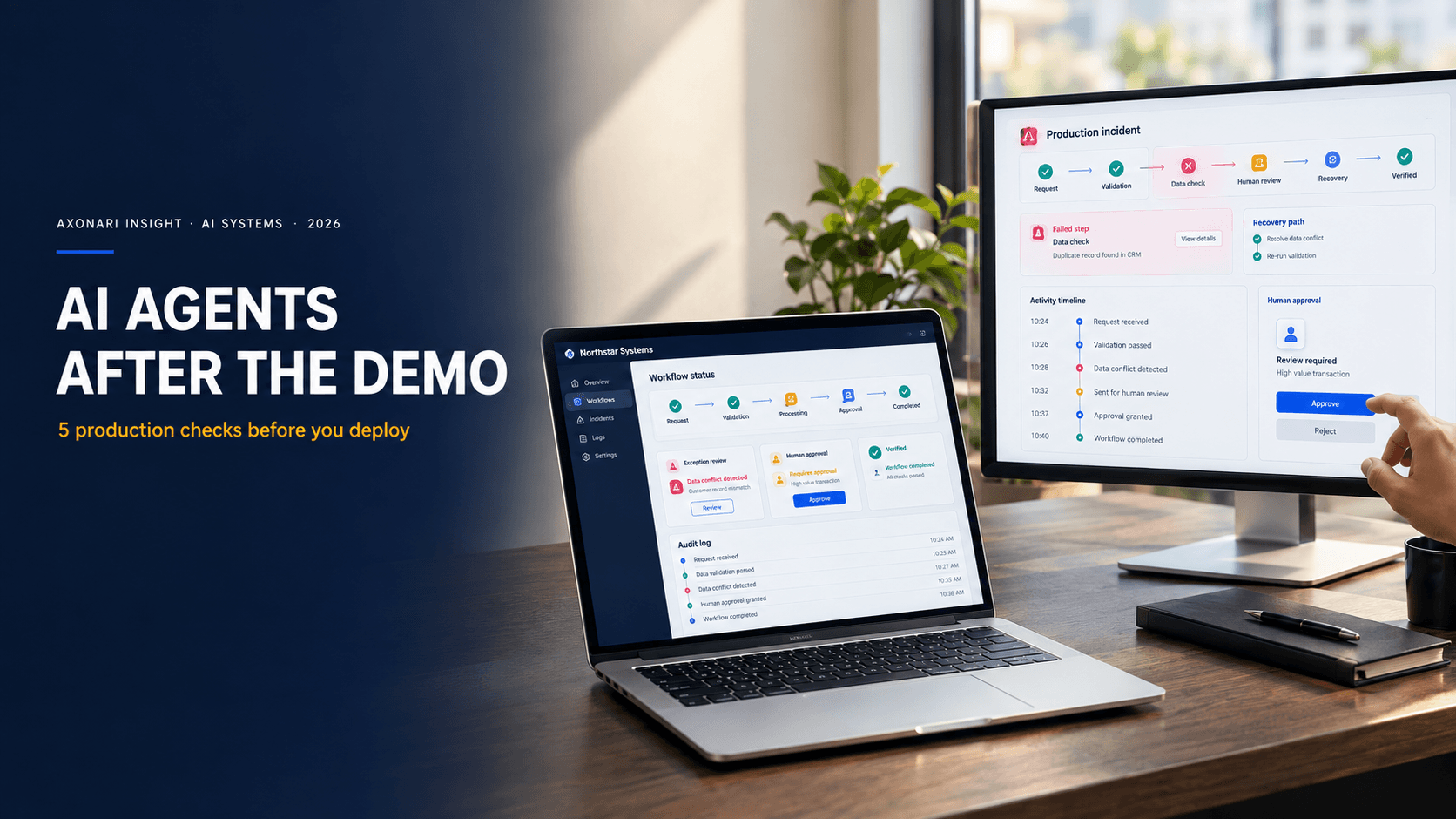
The demo always works. One agent reads a clean request, calls a tool, and returns a tidy answer in front of the whole team. Then it goes live, and real customers send messy requests, two systems disagree about the same order, and nobody can tell which step went wrong.
That gap between demo and production is why AI agents fail after the demo, and where many business automations start to break down. The cause is usually not the AI model. It is everything around it: how the steps are coordinated, who checks the work, and what happens when something unexpected arrives. That coordination layer is what people mean by orchestration.
In this article, "AI automation" means workflows that combine AI models, business software, data and actions. Some need autonomous agents. Many do not. The goal is not to make every workflow agentic. It is to make the right workflow reliable.
TL;DR
Gartner predicts over 40% of agentic AI projects will be canceled by the end of 2027, citing escalating costs, unclear business value, or inadequate risk controls.
UC Berkeley researchers studied multi-agent systems and found failures fall into three groups: system design, agents misaligning with each other, and weak verification of results.
Salesforce Research's CRMArena-Pro benchmark found leading agents achieved around 58% success on single-turn business tasks, dropping to about 35% in multi-turn settings.
Simple, well-defined workflows with clear handoffs are often a better starting point than adding more autonomous agents. Add autonomy only where it earns its place.
Demo vs Production: What Changes
| In a demo | In production | |
|---|---|---|
| Input | One clean request | Duplicate, incomplete or contradictory inputs |
| Tools | One known tool | Several systems with inconsistent data |
| Scenarios | One happy path | Refunds, outages, policy exceptions, escalations |
| Infrastructure | One successful response | Retries, monitoring, logs and recovery |
| Impact | No customer or financial impact | Real customers, money and reputation at stake |
What Does "Orchestration" Actually Mean?
Orchestration is the logic that decides which step runs, which tool gets called, what data gets passed along, who reviews the output, and when a person takes over. A demo hides all of that because one happy path is being shown.
Anthropic draws a useful line in its guide to building agents. Workflows are systems where models and tools are orchestrated through predefined code paths, while agents are systems where the model dynamically directs its own process and tool use. Its advice is to find the simplest solution possible and add complexity only when it demonstrably improves outcomes. Anthropic builds AI models, so this is vendor guidance, but the independent research below points the same way.
When You Do Not Need an AI Agent
Do not use an agent just because a workflow has several steps. A rule-based automation or a fixed AI workflow is usually the better choice when inputs are structured, decisions are predictable and the correct path can be defined in advance. Examples: moving a qualified website lead into a CRM and notifying sales, sending an invoice reminder after a due date, generating a weekly report from known data sources, or routing a support ticket by category.
Consider an agent when the task is genuinely open-ended, needs context from several sources, or cannot be mapped cleanly in advance. Even then, start with limited permissions and defined escalation points.
What the Research Says About Why Agents Fail
Costs and unclear value. Gartner's June 2025 forecast says over 40% of agentic AI projects will be canceled by the end of 2027 because of escalating costs, unclear business value, or inadequate risk controls. It also estimates that only about 130 of the thousands of vendors marketing agentic AI have what Gartner considers genuine agentic capabilities, with others relabeling existing chatbots, assistants or RPA. This is an analyst prediction, not a measured outcome, so treat it as a warning signal.
Gartner's October 2026 analysis, "AI Agent Success Requires Reliability Before Autonomy," makes the same point from the solution side: the challenge is "creating agents that are reliable enough to earn greater autonomy." Its recommended steps include designing human exception handling, building recovery from failures, and measuring reliability systematically.
Coordination breaks down. In "Why Do Multi-Agent LLM Systems Fail?", researchers at UC Berkeley analyzed more than 1,600 annotated traces across seven multi-agent frameworks. They identified 14 distinct failure modes in three categories: system design issues, inter-agent misalignment, and task verification. Put simply, agents fail because of how they are set up and checked, not only because a model gave a poor answer.
Real business tasks are harder than demos. In Salesforce Research's CRMArena-Pro benchmark, leading agents achieved around 58% success on single-turn tasks, but that fell to about 35% in multi-turn settings. The agents also showed near-zero inherent confidentiality awareness. These are benchmark scores, not a universal success rate for business agents, and Salesforce built the benchmark and sells CRM products, so the numbers describe test conditions, not your business. The direction is still clear: real conversations are harder than scripted ones.
2026 data points to the same pattern. McKinsey's State of AI survey (August 2026) found 40% of respondents at large organizations report scaling AI agents, up from 27% a year earlier, while smaller organizations stayed at 22%. Yet only 37% attribute any EBIT impact to AI. Nearly three-quarters of high performers say they fundamentally redesigned workflows because of AI, compared with about one-quarter of other respondents. Deloitte's 2026 report found only one in five companies has a mature governance model for autonomous agents. Stanford's 2026 AI Index reports agent accuracy on the OSWorld computer-use benchmark reached 66.3% in 2025, still below the 72.35% human baseline. McKinsey and Deloitte also sell AI advisory services, and these are broad industry indicators, not predictions of how your own automation will perform.
5 Things to Check Before Your Automation Goes Live
1. Define the handoff points. For every step, write down what comes in, what goes out, and who or what receives it. A common source of agent errors is an unclear handoff.
2. Decide when a human takes over. Low confidence, refund over a set amount, an unusual customer request. Pick the triggers before launch, not after the first incident.
3. Add a verification step. The Berkeley taxonomy lists task verification as its own failure category. Something, whether a rule, a second check or a person, should confirm the output before it reaches a customer or a system of record.
4. Test messy inputs, not clean ones. Try incomplete orders, duplicate records, contradictory instructions and multi-step conversations. If it only passes on the demo script, it is not ready.
5. Log every step. When something breaks, you need to see which step, which input and which decision caused it. Without logs, fixing an automation means guessing.
If you can't explain who checks each step and what happens when it fails, you have a demo, not a system.
How Axonari Helps
In many automation projects, the first issues are practical: data sits in separate tools, ownership of handoffs is unclear, and exception handling was never designed.
Axonari builds connected AI systems that read data from the tools a business already runs, make decisions inside clear rules, take action, and hand off to a person when they should. In practice that means mapping the workflow first, deciding which steps need an agent and which just need a reliable rule, and building in verification and logging from the start.
CloudFO is one example. Its finance team was pulling numbers from Shopify, Xero, QuickBooks, Amazon and several bank accounts and stitching them together by hand. Axonari connected these into one reporting system, and according to CloudFO, reporting became 62% faster and reporting errors fell 70%. Sidechain's HR team reported an 80% drop in manual data entry and 50% faster candidate matching after its systems were connected. Both started with a workflow problem, not an "agent" idea.
Get an automation readiness review. Axonari looks at one workflow you want to automate, finds where it is likely to break after the demo, and gives you a prioritized list of fixes.
Related reading: Multi-agent AI teams: how to orchestrate multiple AI agents without losing control, Why 80% of AI projects fail before they ship, and AI automation governance.
Where to Start
Pick one workflow. Map it step by step. Mark where a person must check the work. Test it with the ugliest real data you have, then go live with logging on.