## Key takeaways
Quick answer: Missed calls cost you clients because most callers don't leave a voicemail. They simply call someone else. An AI phone agent fixes this by answering every call straight away, at any hour, collecting the caller's details and what they need, booking them in or passing them to the right person, and sending you a summary. It works best when every call also flows into your CRM or job system, so nobody is forgotten.
You're on a job, in a meeting or with a customer, and your phone buzzes. By the time you check it, there's a missed call from a number you don't know and no voicemail. Was it spam? A supplier? Or a new client with a £2,000 job who has already booked someone else?
Most small businesses never find out. That's the problem with missed calls: the cost is real, but you never see it on a bill.
This guide shows you how to work out what missed calls really cost your business, the five ways to stop missing them, and how AI phone agents fix the problem when they're set up properly.
Why do missed calls cost you clients?
Because most callers don't wait, and most don't leave a message. When a call isn't answered, people move on to the next business on their list.
The research is clear on this:
The callers most likely to move on quickly are often new customers with an urgent need, exactly the enquiries most businesses least want to miss.
Why calls get missed in the first place
Most missed calls aren't about poor service. They happen because:
What do missed calls really cost your business?
The honest answer is: it depends on your calls. Industry-wide figures like "small businesses lose $126,000 a year" make good headlines, but they don't tell you anything about your business. Work out your own number instead.
Many articles multiply every missed call by your average job value. That overstates the cost, because a lot of missed calls were never going to be clients. When marketing consultant Lilach Bullock tested an AI phone agent on her business line for six weeks, only 34 of the 61 calls it answered were genuine enquiries. Twelve were suppliers or sales pitches.
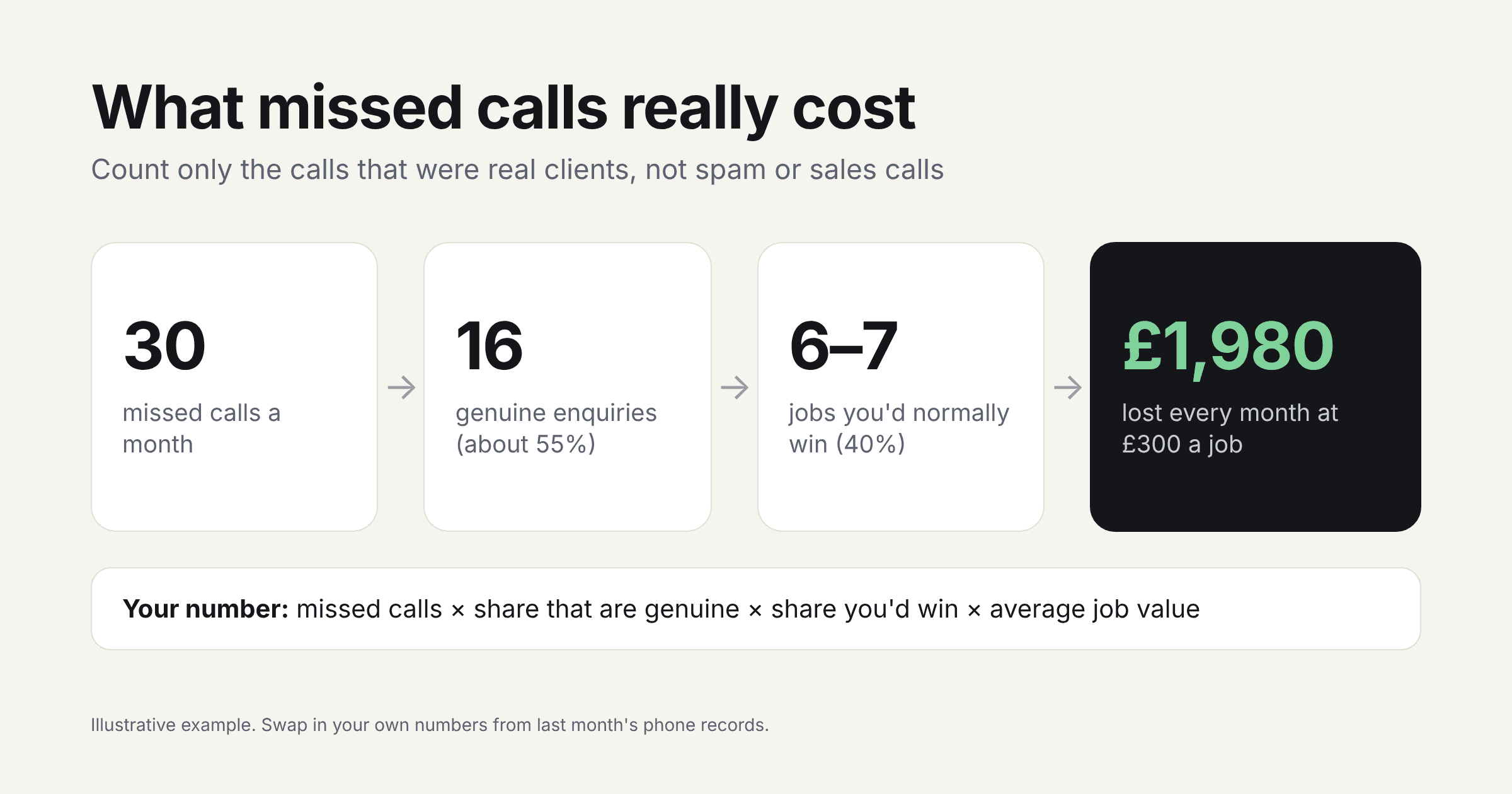
The missed-call cost formula
Use your last month of phone records and this simple sum:
Missed calls × share that are genuine enquiries × share you'd normally win × average job value = monthly cost of missed calls
A worked example
Say a small service business misses 30 calls a month.
| Step | Number |
|---|---|
| Missed calls a month | 30 |
| Genuine enquiries (about 55%, the rest are spam, suppliers and sales calls) | About 16 |
| Jobs you'd normally win from those (40%) | 6 or 7 |
| Average job value | £300 |
| Monthly cost of missed calls | About £1,980 a month, or £23,760 a year |
Your numbers will be different, so swap in your own. The maths works the same in dollars or any other currency. Even if your figures are half of these, missed calls are probably costing you more than an AI phone agent would.
Costs that don't show up in the sum
How can a small business stop missing calls?
There are five main options. Most businesses end up combining two or three.
| Option | How it works | Good for | Weak spot |
|---|---|---|---|
| Answer everything yourself | You or your team pick up every call | Very small call volumes | Impossible while you're working, and nothing after hours |
| Voicemail | Callers leave a message for you to call back | Existing clients who know you | Most new callers hang up instead |
| Missed-call text-back | Anyone you miss gets an automatic text straight away | A cheap first step | They still have to reply, and some won't |
| Human answering service | A team of receptionists answers for you | Sensitive or complex calls | Costs more per call, and may have limited hours |
| AI phone agent | AI answers every call instantly, 24/7 | Busy businesses with lots of routine calls | Some callers won't talk to AI, and it needs good instructions |
How does an AI phone agent fix missed calls?
An AI phone agent answers your calls in a natural voice, works out what the caller needs, and acts on it. Unlike voicemail, the caller gets a real conversation and a next step.
Here's what it does on a typical call:
People are also more open to this than you might think. In the same CallRail survey, 50% of consumers said they would use an AI assistant to book an appointment, and only 13% said they wouldn't use AI for any task.
Where AI phone agents still fall short
For a full breakdown of providers and prices, see our guide to what an AI receptionist costs and how it works.
Why answering the call is only half the fix
This is the part most guides skip. An AI phone agent stops you missing calls, but it doesn't win you the client. The follow-up does.
Lilach Bullock found this in her test. The AI answered the calls, but at first only 19 of the 34 genuine enquiries got a same-day callback. Once she automated the follow-up, same-day callbacks rose from 56% to 91%. The bottleneck wasn't the phone. It was what happened after the call.
So when you set up an AI phone agent, plan the whole journey, not just the answer:
We cover this in more detail in how AI qualifies leads before your sales team talks to them and automating lead routing across CRM, Slack and email.
How do you set up an AI phone agent?
If calls are recorded, tell callers and check the rules where you work. Some places require everyone on the call to agree to recording.
What to measure after launch
Track these numbers every month to see whether it's working:
The last number matters most. If it isn't close to zero, you've swapped a missed-call problem for a slow follow-up problem.
How Axonari can help
Axonari is an AI automation and web engineering practice with offices in London and Jaipur. We don't sell phone agents. We make sure every call, form and chat turns into a follow-up that actually happens.
We're rated 5.0 on Clutch and Top Rated Plus on Upwork. See our AI automation service →
Tired of wondering who that missed call was? Book a free first conversation. Tell us how many calls you miss and what happens to the ones you answer, and we'll show you where the clients are slipping away. Book your free call →
About the author
Kartik Anand is a Partner at Axonari. He works on AI automation for small and growing businesses, including in regulated sectors such as healthcare, financial services and manufacturing.