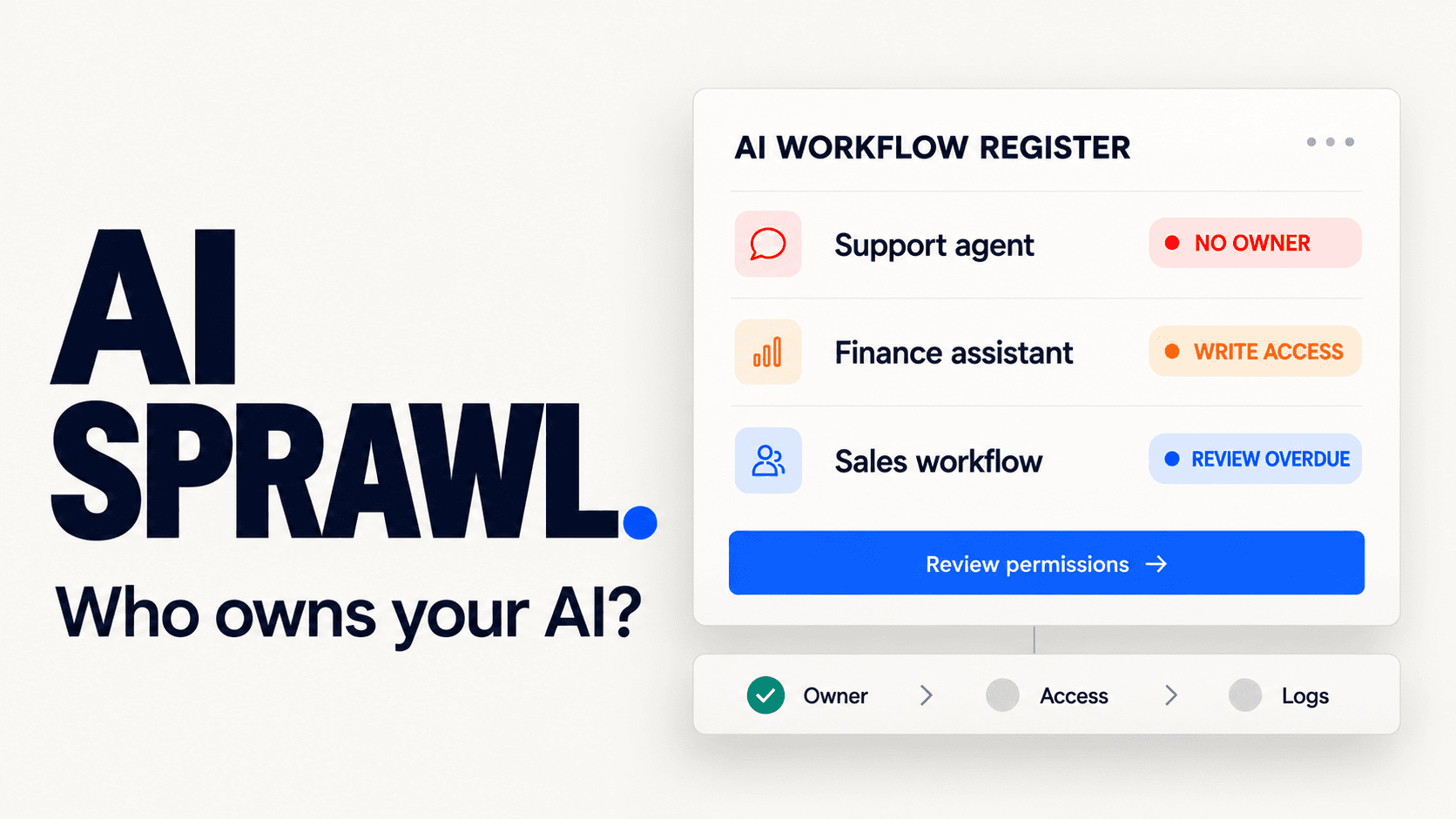
Most companies did not decide to have forty AI tools, six chatbots and a dozen automations nobody fully remembers. It happened one useful experiment at a time. A support bot here, a Zapier flow with an AI step there, a sales assistant someone built over a weekend.
Each one made sense on its own. Together, they often leave a business unable to answer simple questions: what is running, who owns it, what can it touch, and what happens when it gets something wrong? That is AI agent sprawl, and it is a different problem from not having a strategy.
TL;DR
IBM defines AI agent sprawl as "the uncontrolled proliferation of AI agents across an organization."
OutSystems found 94% of surveyed organizations are concerned that AI sprawl is increasing complexity, technical debt and security risk.
IBM's research arm reports only 18% of organizations maintain a current and complete inventory of their AI agents.
You can start fixing it in 30 minutes with a simple list: every AI tool, who owns it, what it can access, and what it can do.
What Is AI Agent Sprawl?
SAP describes agent sprawl as what happens when AI agents are created, deployed or connected across systems faster than the enterprise can inventory them, assign ownership, control permissions, monitor behavior, and retire them when they are no longer fit for purpose.
IBM lists the usual causes: easy low-code and no-code building tools, teams deploying agents for their own tasks without a company-wide program, and no policies for approvals, ownership or retirement. It compares the pattern to SaaS sprawl and shadow IT, which many businesses already know the hard way.
The risks are practical, not theoretical. IBM names duplicated work, agents that bypass audit trails, rising costs from overlapping tools and API usage, and conflicting outputs across departments.
What the 2026 Data Shows
Gartner's April 2026 release projects that an average global Fortune 500 enterprise will have over 150,000 agents in use by 2028, up from fewer than 15 in 2025. In the same release, only 13% of organizations said they think they have the right AI agent governance in place.
Salesforce's 2026 MuleSoft Connectivity Benchmark, a survey of 1,050 enterprise IT leaders, found organizations use an average of 12 agents, and 50% of agents operate in isolated silos. OutSystems surveyed 1,900 global IT leaders: 96% already use AI agents in some capacity, 94% are concerned about sprawl, and only 12% have a centralized platform to manage it. CIO Dive, citing FICO's State of Responsible AI 2026 survey of more than 1,000 senior executives, reports just 8.2% of organizations have adopted a single shared AI deployment platform.
Two caveats. IBM, SAP, OutSystems, Salesforce and FICO all sell products connected to AI governance or integration, so read their numbers as direction, not precision. And most of these surveys cover larger organizations. Smaller businesses may not face the same scale, but the same questions about ownership, access and oversight still apply.
What Sprawl Looks Like in a Smaller Business
Picture a 40-person company (an illustration, not a client story). Marketing uses an AI writing tool. Support runs a chatbot. Sales has a lead-scoring assistant. Operations built a Zapier workflow that drafts replies and updates the CRM. Finance has an AI reporting script a contractor wrote. Nobody is careless. But one support bot says a customer qualifies for a return while another workflow reads an older policy and says they do not, one automation can edit records without approval, and no one has looked at the logs in months.
That is sprawl at SMB scale. It is rarely dramatic. It shows up as quiet inconsistency, duplicate subscriptions, and one bad action that nobody can trace.
The 30-Minute AI Sprawl Audit
Open a spreadsheet and list everything that uses AI or can act on your behalf: chatbots, internal assistants, agents, automations with an AI step (Zapier, Make, n8n), prompt-based tools, AI reporting, and anything that can send messages, update records, issue refunds or read business data.
Then answer five questions for each:
Anything where you cannot answer question 1 or 5 goes to the top of your review list.
The Axonari AI Agent Ledger: A Simple Template
A ledger turns that audit into something you keep. One row per agent or workflow. Here is an illustrative example (the details and the $100 threshold are examples, set your own).
| Field | Example |
|---|---|
| Workflow / agent name | Refund-request triage |
| Business owner | Customer Support Lead |
| Business purpose | Categorize requests and draft replies |
| Approved data sources | Shopify orders, returns app, returns policy |
| Allowed action | Draft reply only |
| Restricted action | Cannot approve refunds |
| Human approval trigger | Refund over $100; unclear order status |
| Performance metrics | Accuracy, escalation rate, response time |
| Monthly cost | $185 per month in licenses, API use and automation runs |
| Last review | October 2026 |
| Kill switch | Disable workflow and route all tickets to the support inbox |
Copy this table into Google Sheets, Notion or Airtable and create one row for every AI agent, chatbot or AI-enabled workflow your business operates.
This lines up with Gartner's six steps for managing agent sprawl: establish agent governance and policies, build a centralized agent inventory, define agent identity, permissions and life cycle, develop AI information governance, monitor and remediate agent behavior, and foster a culture of responsible AI use. The ledger covers the inventory, permission and monitoring steps in a form a small team can actually maintain.
A Quick Self-Assessment
This is a rough rule of thumb to start a conversation, not a scientific score.
| Question | Points |
|---|---|
| Do you have AI tools or agents without a named business owner? | +2 |
| Can any AI workflow update customer or financial records without approval? | +3 |
| Do multiple tools answer the same customer question differently? | +2 |
| Can you not see each AI action or tool call in a log? | +2 |
| Has no one reviewed an automation in the last 90 days? | +1 |
What to Keep, Merge or Retire
Once the ledger is filled in, sort every row into one of three groups.
| Keep or improve | Merge | Retire or pause |
|---|---|---|
| Has a named owner, a defined purpose, logs, clear data sources and human escalation | Two tools that draft the same outreach, support, reporting or CRM updates | No owner, unknown data access, no audit trail, or permission to change customer or financial records without controls |
| Delivers measurable time, quality or cost benefits | Separate agents using the same data but returning different outputs | Dormant agents or expired experiments still using licenses, API credits or sensitive access |
How Axonari Helps
Sprawl is rarely fixed by adding another tool. It is fixed by mapping what exists, deciding what to keep, and connecting the pieces so they share one source of truth.
Axonari starts with an inventory of your workflows and AI tools, then reviews ownership, data access, permissions, logging and human approval points. From there we help consolidate overlapping tools, connect the systems you actually rely on, and build the controls that were missing. That can mean rebuilding a risky automation with proper approvals and logs, or retiring three tools in favor of one connected workflow.
CloudFO is an example of connecting systems instead of adding another tool (it is a data-integration case, not an AI-agent consolidation). Its finance team was pulling numbers by hand from Shopify, Xero, QuickBooks, Amazon and several bank accounts. Axonari connected them into one reporting system, and according to CloudFO, reporting became 62% faster and reporting errors fell 70%.
Related reading: Shadow AI: the hidden compliance risk of unmanaged generative tools, AI automation governance, Multi-agent AI teams and Why AI automations fail after the demo.
Where to Start
Start with the 30-minute list. Name an owner for every row. Mark anything that can change customer or financial records. Review the list again in 90 days. You do not need more AI agents. You need to know which ones are acting on behalf of your business.