Companies are buying chatbots faster than they are creating measurable value from them.
An MIT NANDA report examining more than 300 real AI deployments, plus 52 interviews and a 153-person survey of business leaders, found that most organizations are struggling to turn generative AI pilots into measurable business impact.
Not because the AI was bad. Because it never connected to how the business actually works.
The Chatbot Everyone Bought and Nobody Uses
You have probably seen this play out.
A team adds a chatbot to the website or Slack, calls it done, and a few weeks later nobody is using it. It still hands off anything real to a person. It can talk about your return policy, but it cannot check an order or issue a refund.
MIT's NANDA initiative put a number on this: the researchers found that just 5% of integrated AI pilots were extracting real, measurable value, while the vast majority remained stuck with no measurable impact on the bottom line.
Their explanation was simple. Tools like ChatGPT are great for one person typing questions into a box. Put them inside a real business and they stall, because they never learn how that business actually works.
Full report: The GenAI Divide, MIT NANDA, July 2025
That's the whole problem in one sentence: a chatbot that talks but can't act isn't really doing the job. It's a very articulate dead end.
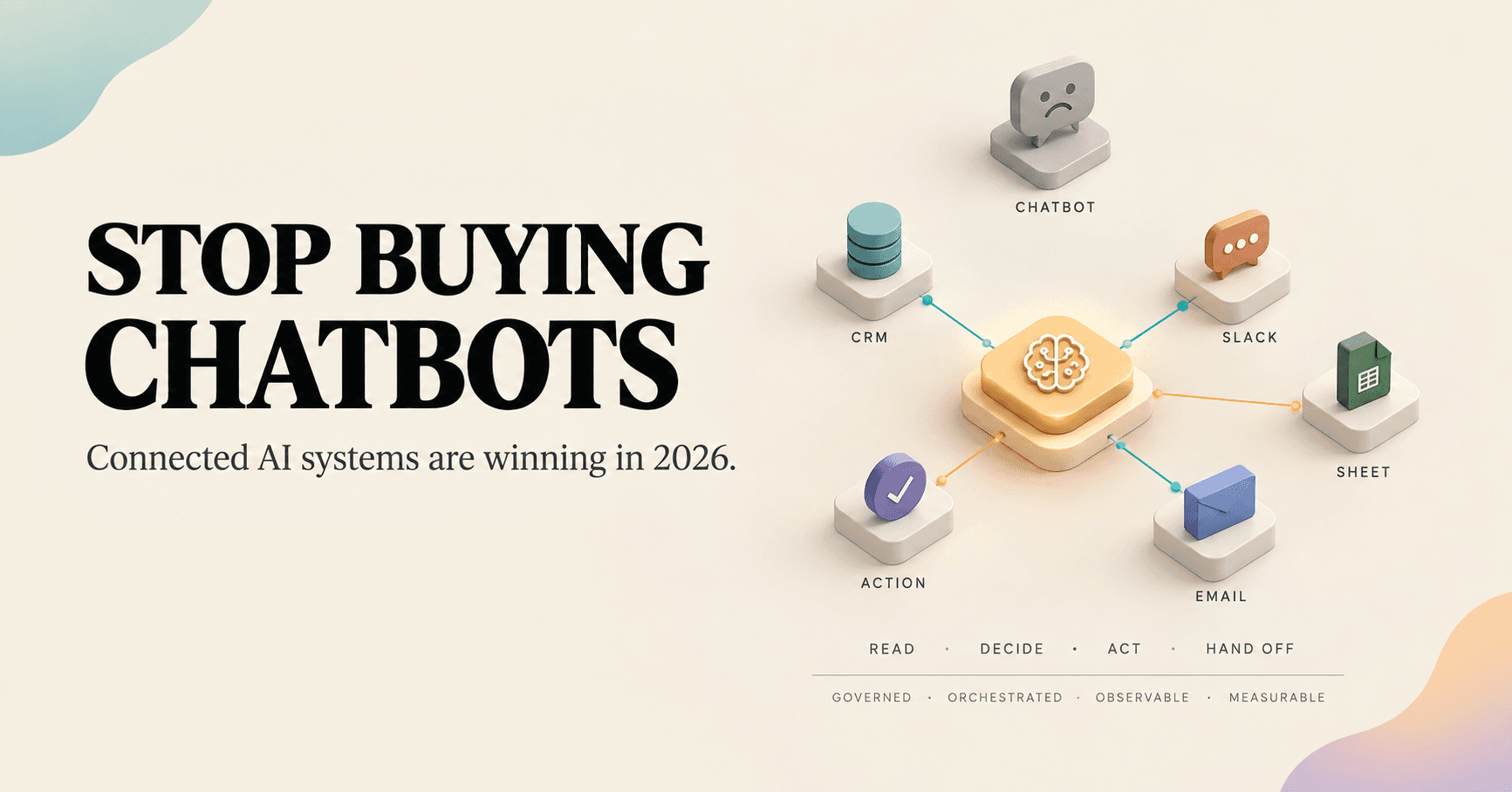
A connected AI system does something different. It can look at your actual data, make a decision within rules you set, take the action itself, and pull in a person only when it should.
This isn't just an MIT finding. Gartner predicts that more than 40% of agentic AI projects will be cancelled by the end of 2027. One reason to be skeptical of the current wave: some products marketed as "agents" are little more than chatbots with a new label, a phenomenon Gartner has described as agent washing.
Gartner press release, June 2025
McKinsey's global AI lead, Alexander Sukharevsky, said something similar in a recent interview: the companies actually getting value from AI redesigned how the work gets done. The ones who just added a tool on top did not.
Direct video from CXOTalk Episode 922.
Standalone Chatbot vs. Connected AI System
| Standalone Chatbot | Connected AI System | |
|---|---|---|
| Answers questions | Yes | Yes |
| Accesses real business data | Limited | Yes |
| Takes action in business tools | Rarely | Yes |
| Executes defined workflows | No | Yes |
| Knows when to involve a human | Basic handoff | Contextual handoff |
| Primary goal | Conversation | Business outcome |
The difference is not whether the system can have a conversation.
The difference is whether it can do something useful inside the business.
What Actually Works: Two Real Examples
CloudFO
CloudFO's finance team was drowning in five different tools: Shopify, Xero, QuickBooks, Amazon, and a handful of banks. None of them talked to each other.
Someone had to manually stitch the numbers together every month, and mistakes crept in.
Axonari connected all five into one system that could answer questions directly. According to CloudFO:
The important part was not the chatbot. It was the connection between the systems.
Sidechain
Sidechain's HR team had the same underlying problem. Candidate details had to be retyped across tools that did not talk to each other, and good applicants slipped through because matching took too long.
Once everything was connected, Sidechain reported:
Neither project started with: Build us a chatbot. Both started with a business workflow being slowed down by disconnected tools.
And both were fixed by connecting those systems.
None of this means chatbots are bad. A chatbot that is genuinely wired into your CRM, checking real records and taking real actions, is already a connected system in every way that matters.
The question was never whether you have a chatbot. It is whether the AI is actually connected to the work, or just sitting in front of it.
3 Places to Actually Start
1. Pick One Workflow, Not One Department
Start with something measurable: lead follow-up, invoice processing, reporting, candidate screening, or customer support.
Do not try to automate an entire department on day one. Pick one workflow where the cost, time, or error rate is easy to measure.
2. Find the Copy-Paste Moment
Look for the point where someone moves information between Salesforce, Slack, Gmail, Shopify, Xero, a spreadsheet, or any other system by hand. That is almost always where a connected system earns its keep fastest.
Every time someone opens one system, copies information, opens another system, pastes the information, makes a decision, and repeats the process, you may have found an automation opportunity.
3. Design the Handoff Before the AI
Before building anything, define what the AI can read, what it can decide, what it can act on by itself, what requires approval, and when it should hand the task to a person.
The human handoff is not a failure. It is part of the system design.
If you cannot draw the workflow, you are not ready to automate it.
How Axonari Helps
That is also the distinction we use at Axonari.
We do not start by asking: Where should we add a chatbot? We start by mapping the workflow, identifying the systems involved, and finding where AI can read, decide, act, and hand off.
CloudFO and Sidechain above are both examples of this approach.
See how we approach AI systems projects
Where to Start
A chatbot that talks but cannot act was never going to be the answer.
The companies actually seeing results connected AI to the systems where the work happens.
Pick one workflow. Find the copy-paste moment. Connect the systems. Start there.
Quick Checklist
If you are only doing one thing today, find the copy-paste moment. That is usually where the real cost is hiding.
Sources
MIT NANDA, The GenAI Divide: State of AI in Business 2025: 300+ deployments analyzed, 52 interviews, and a 153-person survey. Full report PDF
Gartner, Over 40% of Agentic AI Projects Will Be Cancelled by 2027: June 2025 press release. Source
Alexander Sukharevsky, McKinsey QuantumBlack, McKinsey on Agentic AI: How to Create Business Value, CXOTalk Episode 922. Watch the interview