On this page
Executive Summary
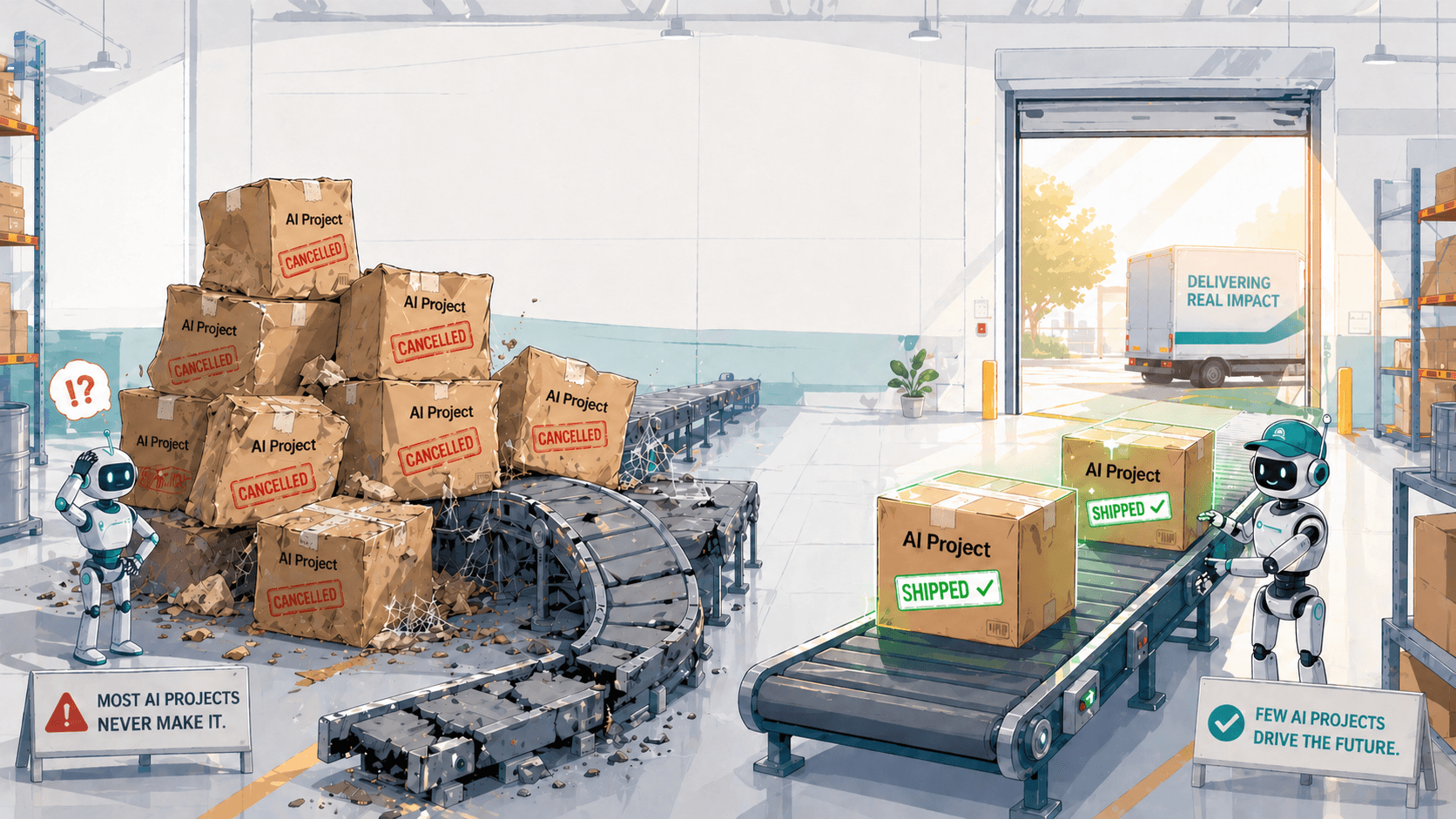
AI projects rarely fail because the technology is broken. They fail because of organizational gaps in strategy, ownership, data readiness, and post-launch maintenance. This guide breaks down the 9 most common failure patterns we've observed and how the successful 20% avoid them.
The '80% failure rate' for AI projects gets quoted so often it's become background noise. Teams nod along, add it to a deck, and then proceed to make the same avoidable mistakes.
Over the past few years, we've delivered 100+ AI builds for everyone from 15-person professional services firms to mid-market businesses with complex legacy stacks. We've seen projects deliver measurable ROI within 90 days. We've also seen projects stall in discovery, get shelved after a flashy demo, or limp to a go-live that nobody uses.
These failures aren't random. They cluster around a small set of predictable patterns and most of them have far less to do with model choice than with how the organisation approaches the work. This is what we've actually observed.
Don't Join the 80% Failure Statistic
Most AI projects fail before they ship. We help companies audit their readiness and build systems that deliver measurable ROI within 90 days.
The explanation people give vs. the real one
When an AI project fails, the public explanation is usually technical: the model wasn't accurate enough, the data wasn't ready, the integration was more complex than expected.
Sometimes that's true. More often, those are symptoms not root causes. The root causes are usually organisational:
• The project champion didn't have enough operational influence to drive adoption
• The problem was never defined precisely enough to build and measure
• The internal team was stretched too thin to partner effectively
• Success was never defined in a way that could be tracked and owned
Technical problems are usually solvable. Organisational problems that get dressed up as technical problems are much harder because the organisation keeps searching for a technical fix.
The Failure Patterns
The common thread
Almost none of these failures are AI problems.
They're business and process failures wearing technical costumes:
The uncomfortable implication for the AI industry: the technology is rarely the hard part. The hard part is the organisational work that has to happen before, during, and after the build and it's the part that gets the least attention.
What the 20% that ship have in common
The projects that succeed share a recognisable profile:
"None of that is glamorous. None of it appears in vendor pitch decks. But it's why those projects ship and why the others don't."
If you're planning an AI build
Before you invest in implementation, be honest about the checklist:
Build for the 20%, Not the 80%
Don't build until you're clear. We help teams identify the right problems, audit their data, and design the workflows that make AI stick.
Further reading & watch list
The Path Forward
AI project failure isn't an inevitability. It's the result of applying 2010s software procurement logic to 2020s probabilistic systems.
By shifting your focus from "Which model should we use?" to "How does this change the way we work?", you join the 20% of organizations that are actually shipping value.
Need an Audit?
Find out why your AI projects might be stalling and how to fix it with our 90-point readiness framework.