## Key takeaways
Quick answer: For most small businesses answering under a few hundred calls a month, an AI voice agent is the cheapest option, usually by a wide margin, because you only pay for the minutes you use and it never clocks off. A virtual assistant is the middle ground: flexible and personal, but you pay for their hours whether the phone rings or not. A traditional call centre is the most expensive route unless your call volume is high and complex enough to need a dedicated, always-available human team.
Every business owner who's missed three calls before lunch has asked the same question: do I hire someone, outsource it, or let an AI pick up the phone?
The honest answer is that "cheaper" depends on how you're actually paying for it. Most comparisons online get this wrong because they compare a headline rate from one option against a headline rate from another, without checking whether those rates measure the same thing. A call centre charges for your agent's time. A virtual assistant charges for their time too, just less of it. An AI voice agent charges for the call itself. Those are three different shapes of cost, which is why the question needs a proper breakdown, not a guess.
So we did the maths, and kept it all in one currency so the comparison actually means something.
What does each option actually cost in 2026?
AI voice agents
AI voice agent pricing in 2026 ranges from approximately $0.05 per minute for bare-bones setups to $0.25 or more per minute for fully managed services. At today's exchange rate, that's roughly 4p to 19p a minute.
The advertised rate rarely reflects the total cost, though. A working AI phone agent stacks several charges together: the phone line itself, the speech-to-text that listens to the caller, the AI model doing the thinking, the voice that talks back, and the platform fee. Add those up and a realistic, fully set-up AI voice agent usually lands somewhere between 6p and 20p a minute, all in.
Outsourced call centres
Basic services like appointment scheduling, order taking and simple enquiries typically run £15 to £22 an hour for UK-based agents, or can be billed as £0.80 to £1.20 per minute, or £3 to £5 per call. More complex calls, the kind involving technical support or anything requiring specialist knowledge, usually cost £28 to £40 an hour.
Across the UK market, the industry average for a fully managed customer service agent sits around £24 to £39 an hour. If you want a dedicated agent rather than a shared one, that's typically a seat-based fee of £2,000 to £3,500 a month per full-time agent.
Virtual assistants
A UK-based virtual assistant charges somewhere between £15 and £35 an hour for general admin work in 2026. Beginners on freelance platforms go as low as £10 to £18 an hour, but most VAs doing anything beyond basic admin sit comfortably in the £20 to £30 range.
Those are the headline numbers. Here's where it gets useful.
Why is the headline rate the wrong number to compare?
The real trap in this comparison is that AI is priced by usage: you pay for the minutes a call actually takes. Human options are priced by availability: you pay for the hours someone is sat there waiting, whether the phone rings or not.
That difference matters more than any of the per-minute or per-hour figures above.
A worked example: 300 calls a month
Say your business gets 300 calls a month, averaging 3 minutes each. That's 900 minutes of actual talk time.
| Option | How it adds up | Monthly cost |
|---|---|---|
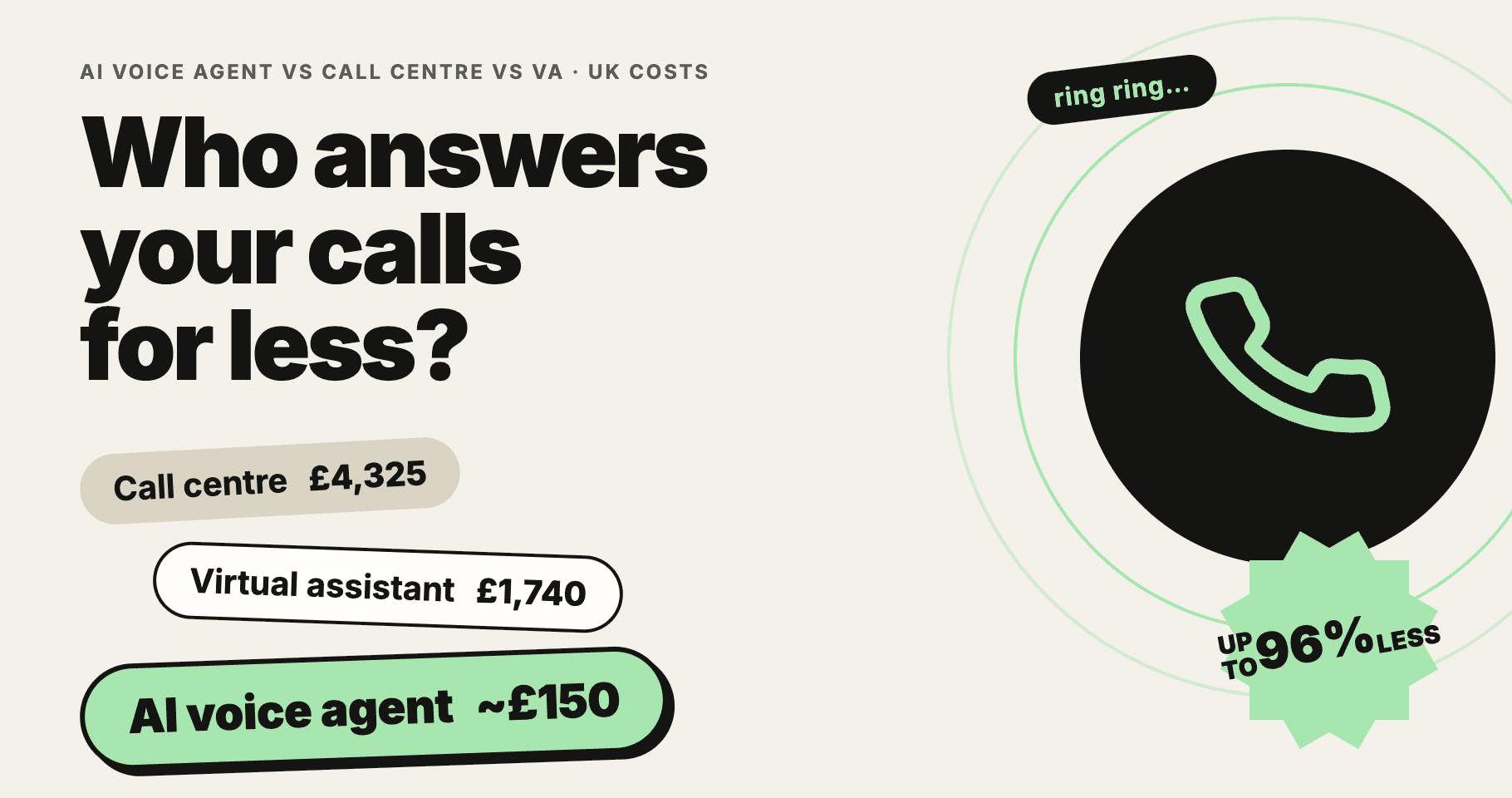
| AI voice agent | 900 minutes at about 14p, plus a modest platform fee | About £150 |
| Call centre, paid per minute | 900 minutes at £1.00 | £900 |
| Part-time virtual assistant | About 87 hours at £20 | £1,740 |
| Call centre, paid per agent-hour | About 173 hours at £25 | £4,325 |
Same business, same call volume, four very different bills. The AI option wins here not because it's magic, but because you're not paying for the gaps between calls.
When is an AI voice agent not the cheaper option?
To be fair to the other two, there are real situations where AI isn't the better deal:
AI isn't the answer to everything. It's the cheaper answer to a specific, very common problem: routine calls that need answering fast, accurately, and outside the 9-to-5.
The honest verdict
For routine enquiries, bookings, order updates and the kind of calls that make up most of a small business's phone traffic, an AI voice agent is the cheapest way to make sure every call gets picked up, usually by several hundred pounds a month compared to the human alternatives, once you account for availability rather than just talk time.
A virtual assistant earns its place when you need a real person handling a mix of calls and admin, and you don't need 24/7 cover. A call centre earns its place when volume is high enough, or stakes are high enough, that a trained human team pays for itself.
Most businesses don't need to pick just one. The ones getting this right use an AI voice agent to catch every call around the clock, and route anything genuinely complicated through to a person. That's the setup that keeps the bill down without losing the calls that matter. For more on setting one up, see our guide to AI receptionists for small businesses, and to work out what unanswered calls are costing you today, read how AI phone agents fix missed calls.
Want to see what this would actually cost for your own call volume? Book a free call and we'll run the numbers with you. No pressure, just the maths. Book your free call →
About the author
Kartik Anand is a Partner at Axonari. He works on AI automation for small and growing businesses, including in regulated sectors such as healthcare, financial services and manufacturing.