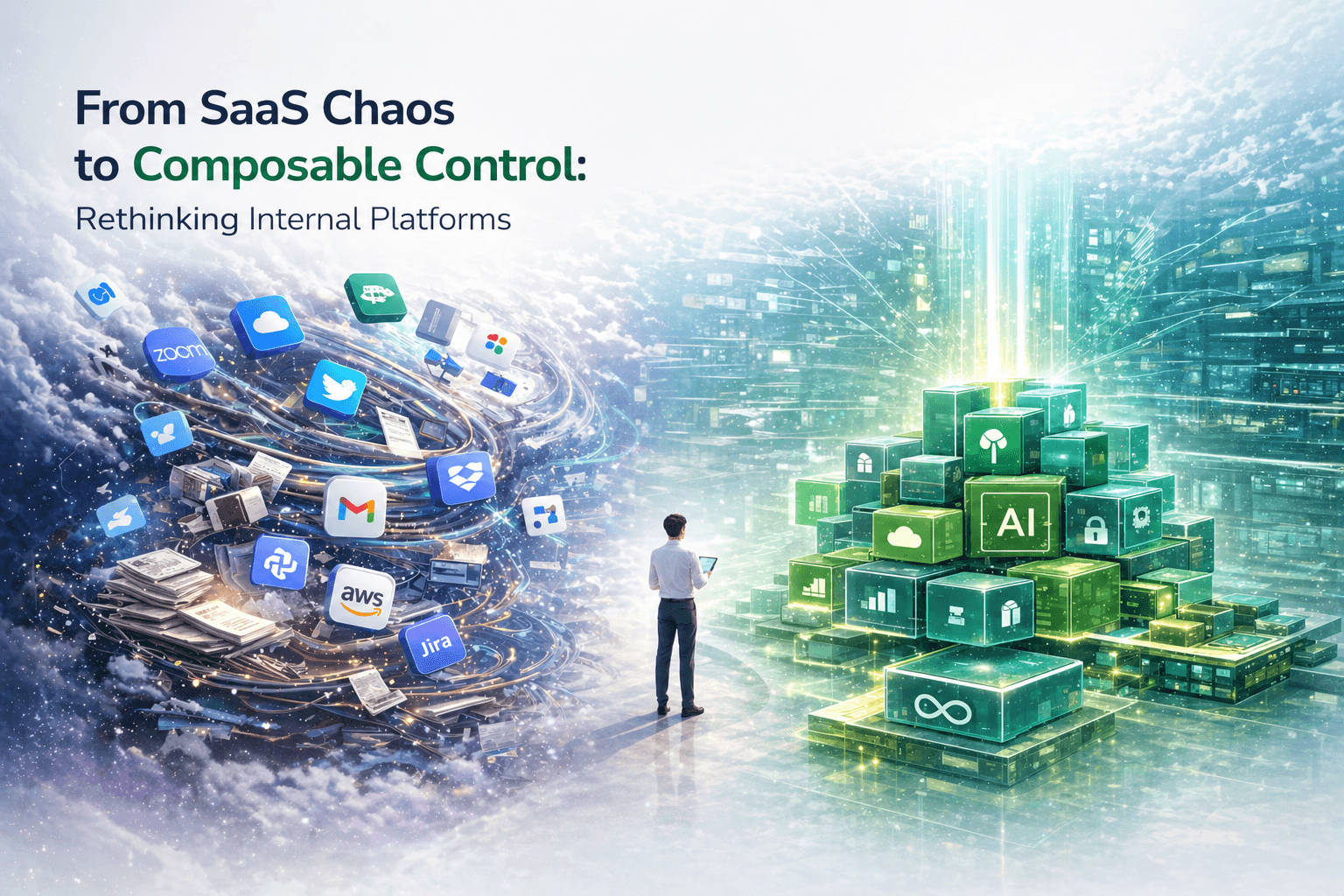
SaaS traps teams in someone else's roadmap. Custom monoliths trap them in yesterday's requirements. The businesses moving fastest in 2026 are avoiding both traps by building composable platforms: modular internal software systems where each capability is a distinct, replaceable service rather than a function buried in a single codebase.
The build-versus-buy framing misses the point. Most organisations end up with both, and the problem is how they integrate. A composable architecture gives you the control of custom software with the flexibility to swap components as your business changes, without rewriting everything each time.
The Monolith Trap
What begins as a helpful internal application becomes a backlog magnet when every new requirement must pass through one codebase, one team, and one release cycle. The pattern is consistent. A team builds an internal CRM to handle their specific sales process. It works well for 18 months. Then the sales process changes, a new region is added, and the integration with the new billing system requires modifications to 14 different files. Every change becomes a negotiation. Every new requirement is weighed against the cost of touching the existing system. The tool that was supposed to accelerate the team now slows it down.
The failure modes compound. When the original developer leaves, knowledge of undocumented dependencies leaves with them. When a security patch is needed in one area, the interconnected nature of the system means testing the entire application before anything ships. When the business wants to add an AI layer, the tangled data model makes it impossible to give the AI system a clean interface to work with.
Custom software often solves the current problem well but ages poorly when the business changes faster than the architecture was designed to accommodate.
What Makes a Platform Composable
Composable platforms are not just modular in code structure. They are modular at the business capability level. Each capability, customer profiles, order management, document processing, approval workflows, analytics, is exposed as a distinct service with a clean API. Any other system, internal or external, can call that capability without knowing how it is implemented internally.
The practical difference is that when the business changes, you change the relevant service in isolation. The customer profile service gets a new field. The approval workflow service gets a new step. The document processing service gets replaced with a better model. None of those changes require touching the other services. The team responsible for each capability owns it end to end.
This is not a new idea. What has changed is the cost of building this way. Infrastructure that used to require a dedicated platform team can now be assembled from managed services, event streaming platforms, and API gateways that handle the operational complexity. The barrier to composable architecture has dropped significantly for organisations that are not at hyperscale.
Why AI Raises the Stakes
AI agents and workflow copilots work best when they can call well-scoped capabilities rather than navigating tangled monoliths. A composable platform gives AI systems cleaner APIs, clearer data boundaries, and safer execution patterns.
Instead of asking an agent to operate a giant internal application, teams can let it query a customer profile service, trigger a risk check, update an activity feed, or initiate an approval workflow as separate controlled actions. Each call is observable. Each outcome is logged. When the agent makes a mistake, you can identify exactly which capability was called with which inputs and why the output was wrong.
In a monolithic system, an AI agent with write access becomes a liability. You cannot control what it touches. In a composable system, you can give the agent access to exactly the capabilities it needs for a specific workflow and nothing else. That makes automation safer to deploy, easier to audit, and far simpler to extend as the use cases grow.
Platform Maturity Model
Most organisations move through a predictable progression as internal software complexity grows. In the first phase, the team uses off-the-shelf SaaS tools connected by point-to-point integrations. Zapier zaps, webhook calls, and shared spreadsheets hold the workflow together. This works until the number of integrations creates a maintenance burden and the SaaS tools stop fitting the actual process.
In the second phase, the team builds custom internal tools: an admin panel here, a reporting dashboard there, a custom API integration for the billing system. Each tool solves the problem it was built for. The problem is that these tools do not share a data model, do not have a common authentication layer, and cannot easily pass information to each other without bespoke connectors.
The real step change happens when the team stops building tools and starts building capabilities: shared services with documented APIs that any internal system, any AI workflow, and any new tool can call. This is the composable phase, and reaching it typically requires an explicit architectural decision rather than emerging naturally from the second phase.
How Axonari Helps
Axonari helps businesses move from fragmented tools and brittle internal systems to composable platforms that support growth. This starts with capability mapping: identifying the core business functions that are currently scattered across multiple SaaS tools, manual processes, and one-off scripts, then designing a service architecture that consolidates them under clear ownership.
The implementation follows in phases, replacing the highest-friction integration points first and building out the shared data layer in parallel. Automation guardrails are designed from the start, so that when AI agents are added to the platform, they have a safe, well-scoped interface to work with rather than broad access to production systems.
Where This Approach Works Best
Composable internal platforms are most valuable when several conditions are true. The business has multiple operational workflows that currently require manual handoffs between different SaaS tools. The team has tried to automate those handoffs and found that point-to-point integrations break frequently or require constant maintenance. A new capability, AI document processing, a new pricing model, a new compliance requirement, would require changes across multiple existing systems to implement. The organisation is planning to add AI automation and wants to do so in a way that is observable, controllable, and extensible rather than ad hoc.
If only one of these conditions applies, a composable platform is likely over-engineered for the current stage. The right starting point is usually a single well-built internal service that handles the highest-friction capability, built with a clean API from day one so that it can become part of a larger platform later.
Key Takeaways
Composable internal platforms sit between off-the-shelf SaaS and rigid custom monoliths. They give organisations a way to own the workflows, data access patterns, and automation logic that matter most, while remaining flexible enough to evolve as the business changes. The architectural decision to build composably is also the decision that makes AI integration safe and scalable. Organisations that make this transition before trying to add AI automation avoid the most common and expensive failure mode: an agent with too much access and too little structure.
For related reading on how automation architecture choices affect long-term ROI, see our articles on business process automation in 2026 and Zapier vs custom automation.
Ready to Build a Composable Platform?
We will map your current capabilities, identify the highest-friction integration points, and design a platform architecture that supports growth without requiring a rewrite every eighteen months.