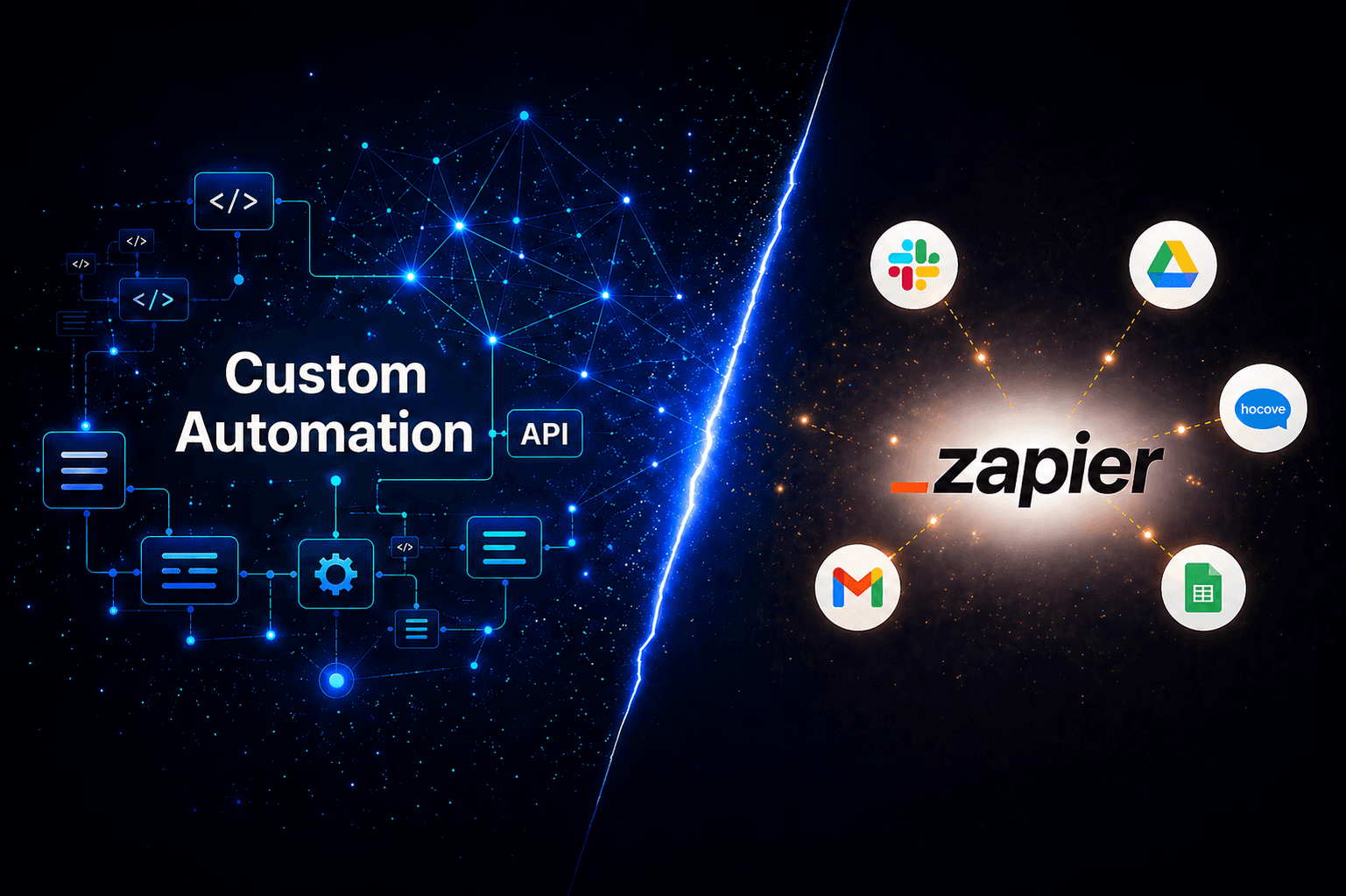
The Promise of No-Code Automation
Every company has its beginnings. For the majority, Zapier is the beginning of a no-code automation solution that promises to link your apps, get rid of tedious work, and free up hours for your team. It also delivers. For millions of businesses, Zapier truly works.
But eventually, Zapier starts to feel more like a ceiling than a launching pad sometimes gradually, sometimes abruptly. Workflows get more complicated. Expenses begin to rise. There are a lot of edge cases. And your group begins to wonder if it would be better to create something unique.
This blog explains the actual distinctions between custom automation and Zapier, the statistics supporting each strategy, and above all the telltale signs that indicate when it's time to switch. For more on the basics, see this Zapier Beginner Tutorial.
Understanding the Two Approaches
What is Zapier?
With pre-built integrations, Zapier, a no-code automation platform, links more than 8,000 apps. Without knowing a single line of code, users can construct Zaps trigger-action workflows. It is easy to use, quick to set up, and effective for simple automations like updating spreadsheets, sending Slack notifications, and syncing CRM data.
Over 3 million businesses trust Zapier, which is expected to generate $400 million in revenue by 2025, with an annual growth rate of about 29% (Source: SQ Magazine).
What is Custom Automation?
Building automation workflows with code, APIs, or developer-grade platforms that are especially suited to your business processes is known as custom automation. From a Python script that synchronizes proprietary databases to a completely custom integration layer created with tools like n8n, Pipedream, or an internal API, this covers it all.
Though it necessitates more development resources and longer build times, custom automation provides complete control over logic, data flow, error handling, and scalability.
The Case for Staying with Zapier
Zapier isn't a flawed tool, it's a purpose-built platform that delivers exceptional value within its ideal use cases. Here's where it truly shines:
))} Reference: zapier.com | zapier.com/pricing
Not Sure If Zapier Still Fits Your Business?
We help scaling businesses audit their automation stack and identify where custom solutions using APIs deliver better ROI.
The Case for Custom Automation
Custom automation is not limited to large development teams and enterprise organizations. When Zapier's shortcomings begin to cost you money, dependability, or opportunity, it becomes pertinent.
))} The Data: What Research Actually Says The Automation Numbers. Gartner, Forrester, Microsoft & Gaazzeebo research
RPA Market Size (2025)
Growing at over 23% annually (Market Report)
Three-Year ROI
Forrester TEI study, payback < 6 months
Annual Zapier Cost at Scale
Businesses running 50,000+ tasks/month on Zapier's premium tiers.
Source: Gaazzeebo 2025
Zapier Polling Interval
Free/Starter plans poll every 15 minutes. Not real-time.
Custom Processing Speed
Custom automation processes events instantly via webhooks and APIs.
Data Compliance
GDPR, HIPAA, SOC 2 self-hosted means data never leaves your servers.
Key Signs It Is Time to Stay with Zapier
Use these as your decision checklist. If three or more apply to your business, sticking with Zapier is likely the smartest and most efficient choice right now.
))} The Middle Ground: A Hybrid Approach Switching to custom automation does not have to mean abandoning Zapier entirely. Many scaling businesses use a hybrid strategy that combines both approaches strategically.
Use Zapier For
Use Custom Automation For
Tools to Consider Beyond Zapier
Compare platforms like n8n vs Zapier or Zapier vs Make vs n8n to choose the best fit.
How Axonari Helps You Scale
At Axonari, we help businesses transition from no-code to custom automation, unlocking scalability, reliability, and cost efficiency. Whether you need a complete migration or a hybrid strategy, our team builds the right system for your growth stage.
Your Guide to Zapier
A complete tutorial showing how to set up your first automation and manage your workflows effectively.
Final Thoughts
Zapier will always be the right tool for a certain stage of business. Fast to set up, broad in integrations, and easy for non-technical teams it earns its place in early-stage and lean operations.
But automation is infrastructure. And just like any infrastructure, it needs to evolve as your business grows. The moment Zapier starts slowing you down, costing you more than it saves, or creating compliance risk, it has become the wrong tool for the job.
The good news is that the transition does not have to be dramatic. A hybrid approach using Zapier where it fits and custom automation where it matters gives you the best of both worlds. The key is knowing where the line is.
Start by auditing your most expensive and most critical Zaps. Those two categories usually tell you everything you need to know.
Related services
Ready to Scale Your Automation?
Book a today and see how we can help you build automation that scales.
Axonari. Automation that grows with you.
Related Insights
The Rise of Internal Tool Builders
Why every growing company needs a dedicated role for operation tools.
Agentic AI in Action: 3 Success Stories
See how autonomous agents are transforming healthcare and finance.