SaaS companies that ship AI see 2–4× higher net revenue retention.
SaaS companies that ship AI features see 2–4× higher net revenue retention. The companies falling behind aren't slower builders they're building the wrong things.
The pattern is consistent: AI-powered onboarding drives faster activation, in-product AI assistants increase daily usage, and automated churn signals give customer success teams the lead time they need to intervene. None of these require training a frontier model. Most can ship in weeks using existing API infrastructure.
The question isn't whether to add AI to your SaaS product. It's which AI features will actually move retention metrics and which are table stakes your competitors have already shipped.
4 Ways to Add AI to Your SaaS Product
These four approaches consistently deliver measurable impact on activation, engagement, and retention and each maps to a different part of the product lifecycle.
Build vs API: How to Choose
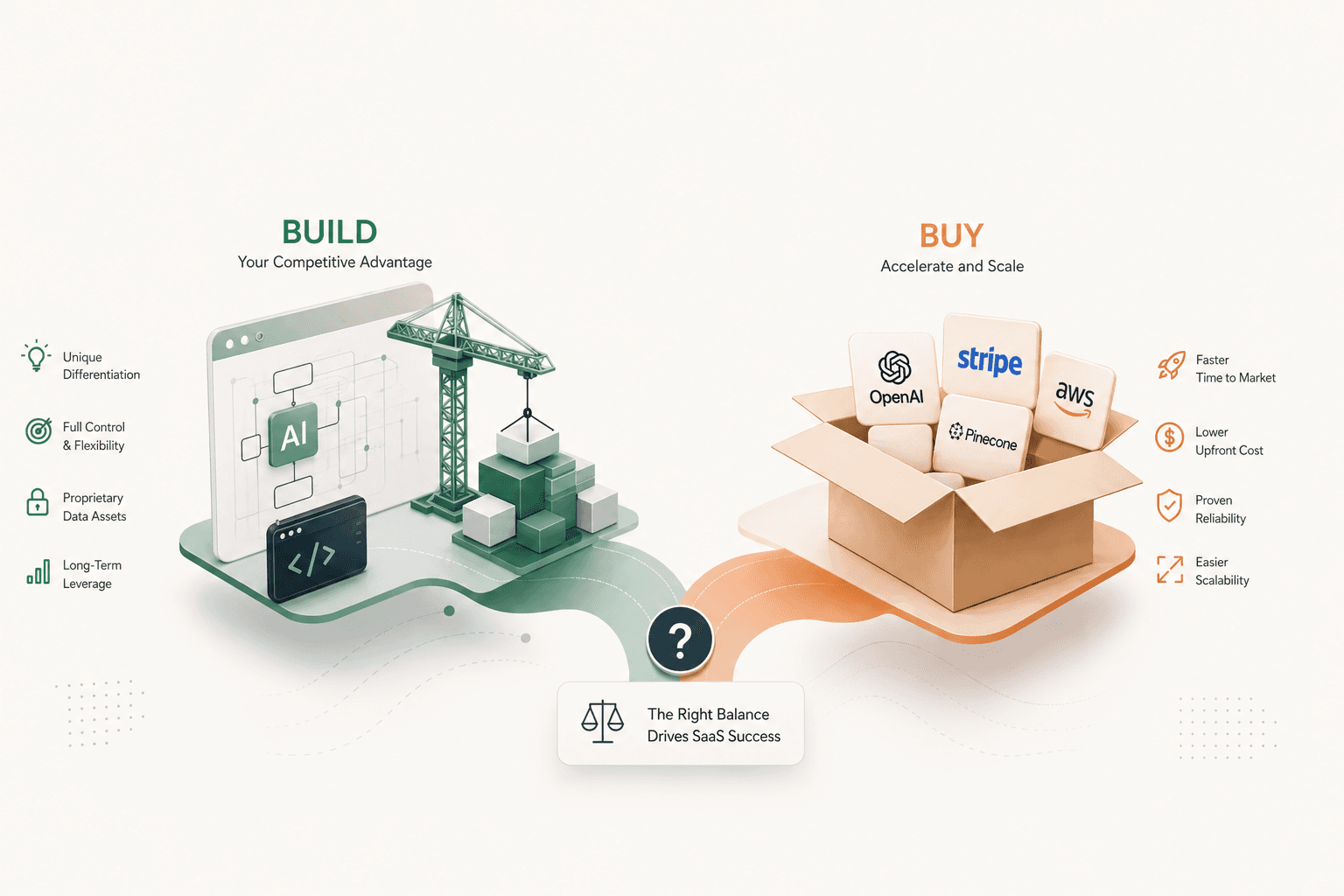
Most SaaS teams face the same question: use OpenAI or Anthropic's API, or invest in a custom or fine-tuned model? The answer depends on whether you need speed-to-market or long-term competitive differentiation.
OpenAI / Anthropic API
Fast to ship 4–8 weeks
Lower upfront cost: £10–50k
Loses differentiation if competitors do the same
Dependent on third-party pricing and uptime
Best for: shipping fast, validating AI features before deeper investment
Fine-Tuned / Custom Model
Genuine moat when trained on proprietary data
Higher performance on domain-specific tasks
Slow to build: 3–6 months
Higher investment: £50–150k
Best for: core product differentiation where proprietary data is the advantage
The practical approach: Start with API-based features to validate the use case and build user familiarity. Once you understand exactly how users interact with the AI capability and have proprietary interaction data, evaluate whether a fine-tuned model makes economic sense.
How AI Reduces Churn
AI reduces SaaS churn through three distinct mechanisms. Each operates at a different point in the customer lifecycle.
The compounding effect matters. A SaaS product that improves activation, detects at-risk accounts, and drives daily usage is attacking churn at every stage simultaneously not just patching one leak.
Case Study: TrainED
TrainED Scalable Multilingual AI Assessments
TrainED needed a scalable learning platform that could deliver multilingual AI-powered assessments, personalise course recommendations, and automate the operational overhead of managing a growing user base. Axonari built the interactive learning platform with automated course recommendations and AI-powered assessment logic that scaled without adding headcount.
"They shipped our platform faster than we expected and the automation they built has cut our ops overhead significantly."
Cost to Build AI Features
Cost varies significantly depending on whether you're adding an API-based feature or building a custom AI capability for core product differentiation.
Note on pricing: These ranges reflect typical engagements for SaaS companies building meaningful AI features not simple chatbots. Scope, data complexity, and integration depth all affect final cost. A scoping call is the fastest way to get an accurate estimate for your specific product.
Key Takeaways
Ready to Ship AI Features That Actually Retain Users?
We'll scope the right AI features for your SaaS product and give you a clear build plan API-based or custom with honest timelines and costs.