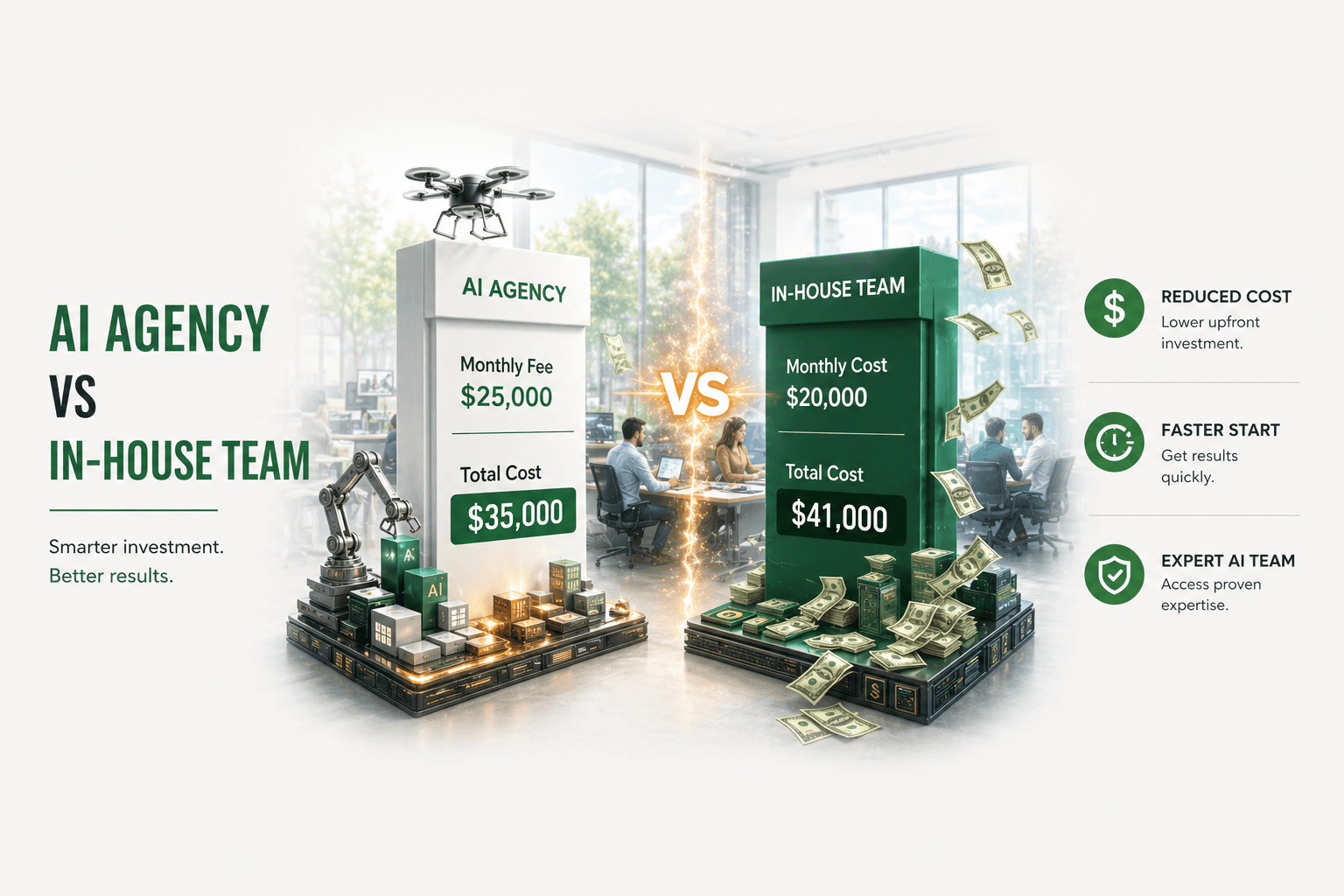
An AI agency wins on speed and breadth. In-house wins on domain depth. Most UK businesses need to be honest about which of those matters more right now.
When a CTO asks whether to hire AI engineers or work with an agency, the honest answer depends on four factors: how fast you need to move, how proprietary your data and logic really are, whether you can hire the right people in time, and whether you want to own this capability permanently or ship a working system this quarter.
The True Cost of Hiring In-House
The mistake most teams make is comparing a recruiter's salary figure to an agency day rate. The real comparison is total cost of ownership over twelve months, including the hidden costs that rarely appear on a hiring plan.
A mid-level AI engineer in London in 2026 commands a base salary of £90,000 to £130,000. Add employer National Insurance at 13.8%, pension contributions of 5 to 10%, equipment, software licences, office space allocation, and recruiter fees of typically 15 to 20% of first-year salary, and the true year-one cost sits between £160,000 and £290,000 before the person has shipped a single production model.
The time cost compounds the financial cost. The average time to hire a senior AI engineer in the UK is 12 to 16 weeks from opening the role to start date. Onboarding takes another four to eight weeks before the person is productive in your specific environment. In most project contexts, that timeline is the entire available window.
The first in-house hire rarely ships production AI in year one. Between recruiting, onboarding, domain knowledge transfer, and the inevitable discovery that the first approach does not fit the data environment, most organisations spend over £200,000 before a system reaches production. An agency engagement covering the same output typically costs £20,000 to £80,000 and ships in six to twelve weeks.
Speed to Value
Time is the dimension most organisations underestimate. Building an in-house AI team is not just expensive, it is slow. And in most business contexts, a working AI system shipped in six weeks delivers more value than a perfect one delivered in nine months, because the opportunity cost of waiting is real.
An agency brings existing infrastructure: a team with production AI experience, tested integration patterns, known failure modes, and the ability to start delivering in the first week rather than the fifth month. For a business with a deadline, a competitive pressure, or a specific project to ship, that difference is decisive.
For a Series A company that needed an AI document processing pipeline operational before their funding closed, the eight-week window made in-house hiring impossible. An agency delivered a production-ready system in five weeks. The company closed their round. The counterfactual, spending sixteen weeks on hiring plus eight weeks of onboarding, was never viable.
When In-House Wins
In-house is not always the wrong answer. There are specific conditions where owning the capability permanently is clearly the right call.
The strongest case for in-house is when the AI capability is your core product, not a feature or an operational tool. If you are building an AI-native product where model performance is the primary competitive differentiator, and that product will evolve continuously based on proprietary data you are accumulating, you need a team that lives inside the model and improves it daily. An agency cannot replicate that depth.
In-house also wins when you have truly proprietary data and logic that cannot safely leave your infrastructure, when regulatory requirements mandate that model development and oversight remain with named employees rather than third parties, and when the capability is so central to the business that losing it overnight would be catastrophic. Those conditions exist in some large enterprises and regulated institutions. They are far less common than the organisations claiming them suggest.
The honest check is to ask: in two years, will we need a team of AI engineers working full-time on this capability, or will we need a well-built system that runs reliably with occasional maintenance? The first case points toward in-house. The second case almost always points toward agency.
When an Agency Wins
An agency wins in the majority of early-stage AI adoption contexts. The pattern is consistent: organisations that try to hire their way into a first AI deployment almost always ship later, spend more, and take on unnecessary hiring risk compared to those that partner with an agency for the first system and then make the in-house hiring decision from a position of information rather than speculation.
A finance team that needed an AI agent to automate document extraction and compliance checks had a six-week delivery window. Hiring was not an option. An agency delivered a production-ready system processing thousands of documents monthly. The team then hired one engineer six months later to maintain and extend it, with full context from working alongside the agency during handover.
An edtech startup needed AI-powered personalisation built into their LMS before a major partnership launch. An agency augmented their existing engineering team, bringing AI expertise without a new hire, and shipped on time. The startup then had a working system and production experience to inform what kind of in-house engineer they actually needed, rather than hiring speculatively.
Decision Framework
Score your situation across these five questions. Award 1 point for each answer that points toward agency. A score of 3 or above means an agency engagement is likely the right starting point.
Do you need the system live within 16 weeks? If yes, agency. Do you have the budget to absorb £200,000 before shipping? If no, agency. Is AI a feature of your product or the product itself? If a feature, agency. Do you have an existing engineer who can take over maintenance post-launch? If yes, agency is viable for the build. Is your team currently able to evaluate AI engineer candidates accurately? If no, agency first.
Score 4 to 5: strong agency case. Score 2 to 3: consider a hybrid, agency for delivery with in-house for ongoing ownership. Score 0 to 1: in-house is likely the right long-term investment.
How Axonari Works as Your AI Partner
We work as an extension of your team. You keep ownership of all code, models, and data pipelines. Every project closes with full documentation, a clean architecture, and a runbook for operational tasks. Your internal team can take over, extend, or maintain anything we build without our involvement. We also offer structured handover periods where your engineers pair with ours during the final weeks of an engagement, so knowledge transfer happens in context rather than through documentation alone.
Key Takeaways
The year-one cost of an in-house AI engineer in the UK is £160,000 to £290,000, versus £20,000 to £80,000 for an agency delivering equivalent output. Time to productivity for an in-house hire is typically 20 to 24 weeks from role opening to first production system. An agency can ship a production system in 6 to 12 weeks. The right answer depends on whether AI is your core product or a tool that supports it. Most early-stage AI adoption should start with an agency and hire in-house once there is a working system to inform the hiring decision.
Ready to Move Faster on AI?
Not sure whether to hire or partner? We will give you an honest assessment of which model fits your situation, even if the answer is that you should build in-house.