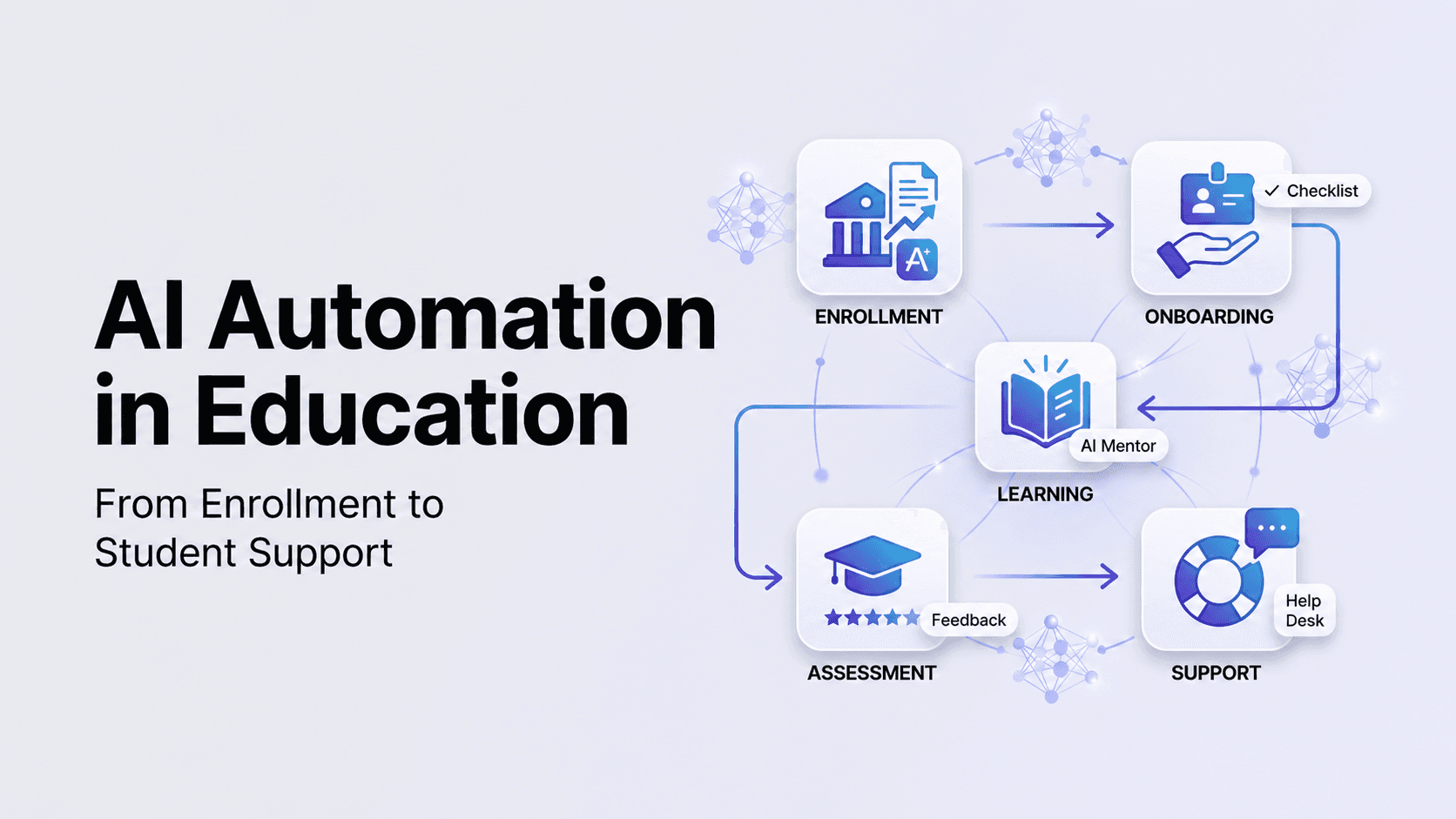
Education AI that frees educators to teach.
Education institutions face a growing paradox: student expectations for personalised support are rising while administrative burdens consume more staff time every year. Enrollment processing, student queries, scheduling, grading, compliance reporting, and financial aid administration absorb resources that should be directed toward teaching and learning outcomes.
AI automation handles the high-volume administrative tasks that scale with student numbers, letting educators and support staff focus on the interactions that genuinely require human judgement, empathy, and expertise.
Institutions using AI-powered admissions workflows report a 60% reduction in enrollment processing time, with application-to-decision cycles dropping from several weeks to two to three days. That acceleration improves the candidate experience, reduces drop-off during the decision window, and frees admissions staff for relationship-building with prospective students rather than document processing.
6 Workflows That Deliver Real Results
These workflows address the operational challenges that scale with student numbers. Each one reduces administrative burden while improving the student experience.
Enrollment and admissions automation handles the full application intake cycle: document collection and verification, eligibility checks against entry requirements, communication sequencing from acknowledgement to conditional offer, and enrolment confirmation. Manual application processing typically requires 20 to 40 minutes of staff time per applicant. Automated workflows reduce that to under five minutes of exception handling for complex cases, allowing admissions teams to process significantly higher volumes without proportional headcount growth.
Student query handling and support triage routes inbound queries across email, web chat, and student portal to the right team or resource automatically. Common queries about timetables, fee deadlines, module choices, and assessment submission receive instant, accurate responses from a knowledge base the institution controls. Staff see only the queries requiring genuine human judgement, typically 20 to 30% of total volume, rather than answering the same questions repeatedly across the year.
Early warning and retention systems monitor attendance records, assessment submission patterns, portal login frequency, and library access to generate weekly risk scores for every active student. Students showing early signs of disengagement receive a prompt outreach from their personal tutor or support team before a problem becomes a withdrawal. Institutions using these systems report retention improvements of 15 to 25%, and given that the average cost of a domestic undergraduate place lost to early withdrawal exceeds 7,000 pounds in tuition and associated funding, the ROI is clear.
Timetabling and scheduling automation handles room allocation, staff availability, module capacity constraints, and student preference data to generate optimised timetables faster and with fewer conflicts than manual processes. Timetable changes are propagated automatically to student apps, staff calendars, and room booking systems, eliminating the cascade of manual updates that typically occupies timetabling teams for weeks at the start of each term.
Compliance and safeguarding reporting automates the data collection and formatting required for statutory returns including HESA data collections, Prevent duty reporting, and safeguarding referral logs. Automation ensures data is pulled from source systems accurately and submitted on time, reducing the risk of errors that can attract scrutiny from regulators. For SEND and welfare data specifically, automated workflows maintain audit trails required under the Children and Families Act 2014 without manual logging.
Financial aid and fee processing automation handles bursary eligibility checks, scholarship application processing, and fee instalment schedule management. Automation cross-references student records against eligibility criteria, generates award letters, and updates finance systems without manual data re-entry. Outstanding fee reminders are sent on a defined schedule with escalation logic, reducing debt management overhead and improving collection rates.
Data Privacy and Compliance
Education AI operates across some of the most sensitive personal data categories in any sector: student welfare records, SEND assessments, attendance data, and academic performance. Since 5 February 2026, UK GDPR Articles 22A to 22D (substituted for Article 22 by the Data (Use and Access) Act 2025) govern automated decisions with legal or similarly significant effects. For ordinary personal data the default is now permission plus safeguards rather than prohibition. Special category data, which covers SEND assessments and welfare records, stays restricted under Article 22B. Any automation that determines admissions outcomes, progression decisions, or financial aid eligibility must still include a meaningful human review step before the decision is communicated to the student.
Special category data, including SEND records, mental health disclosures, and safeguarding case notes, requires either explicit consent or a public task lawful basis under UK GDPR Article 9. Data Protection Impact Assessments are mandatory for any processing that is likely to result in high risk to individuals, which covers most early warning systems and welfare monitoring tools. Institutions should ensure DPIAs are completed before deployment, not as a post-launch exercise.
ROI Benchmarks
Enrollment automation consistently delivers the fastest payback period in education: the combination of staff time savings and improved yield from faster offer turnaround typically generates a positive return within six to nine months. For a mid-size higher education institution processing 5,000 applications per cycle, a 60% reduction in per-application handling time represents several thousand hours recovered annually.
Retention automation has the highest long-term ROI of any education workflow. The cost of recruiting a new domestic undergraduate to replace one who has withdrawn is estimated at between 8,000 and 12,000 pounds when marketing, admissions processing, and funding loss are included. Retaining an at-risk student who would otherwise have withdrawn typically costs under 500 pounds in additional support. At a retention improvement of 15 to 25%, the economics are compelling at almost any implementation cost.
Student query automation reduces first-line support headcount requirements. Institutions that deploy AI query handling report that 60 to 80% of inbound queries resolve without staff involvement. For institutions handling tens of thousands of inbound queries per year across admissions and student services, that represents a significant reconfiguration of support capacity.
Implementation Approach
The lowest-risk starting point for education AI is student query handling. The workflow is high-volume, the data involved is relatively non-sensitive, and the quality of responses can be validated quickly by reviewing conversations. A well-scoped query automation project typically takes eight to twelve weeks from brief to live deployment.
Enrollment automation and early warning systems follow once the team is comfortable with how automated workflows perform in practice. Each subsequent workflow can be built on the data infrastructure established for the first, reducing marginal implementation cost. Multi-workflow programmes covering admissions, student services, and compliance reporting typically run four to six months end to end.
For automation under compliance-heavy environments, see also AI automation in UK healthcare and AI automation for law firms. Our AI Automation service covers end-to-end design, build, and deployment for education institutions.
Ready to automate your education operations?
We will identify your highest-impact automation opportunities and build compliant systems that free your team to focus on student outcomes.