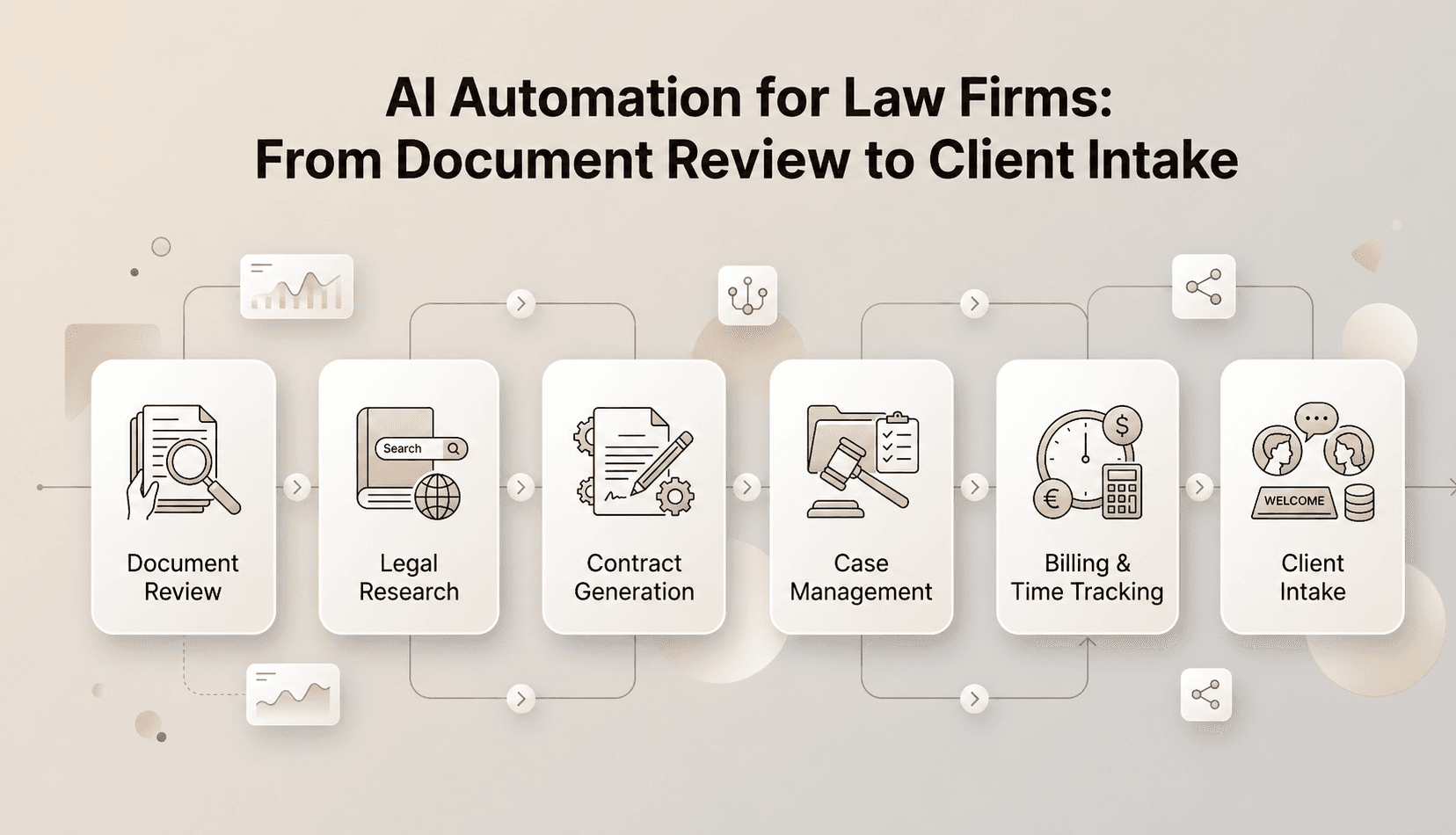
Legal AI automation that amplifies judgement, not replaces it.
Law firms operate on one of the most time-intensive business models in any industry. Associates spend 60% or more of their capacity on tasks that require attention but not necessarily legal judgement: document review, contract comparison, due diligence data extraction, intake form processing, and compliance checks.
AI automation handles the volume work so lawyers can focus on the high-value analysis, strategy, and client counsel that justify premium billing rates. The firms adopting it are not cutting lawyers. They are making each lawyer dramatically more productive.
Firms using AI-powered contract analysis tools report a 70% reduction in document review time, with accuracy rates that match or exceed manual review for standard clause identification. An associate who previously spent two days reviewing a data room of 200 documents can now review the AI output and focus on flagging genuine legal risk in a fraction of that time.
6 High-Value Workflows to Automate
These workflows represent the greatest time savings with the lowest risk to client outcomes. Each keeps human judgement where it matters while automating the preparation and processing layers.
Contract review and comparison is the highest-volume starting point for most firms. AI tools extract and compare key clauses across NDAs, MSAs, employment contracts, and supply chain agreements: liability caps, indemnification language, termination rights, payment terms, and governing law. The system flags deviations from the firm's standard positions, highlights missing clauses, and presents a structured summary for the reviewing solicitor. What took four hours takes forty minutes.
Due diligence document extraction automates the analysis of data rooms for M&A, property transactions, and corporate finance work. AI reads and categorises hundreds of documents, extracts key dates, obligations, and risk factors, and populates a due diligence report template. The solicitor reviews the extracted findings and applies legal judgement to materiality and risk, rather than spending the majority of their time on extraction itself.
Client intake and matter opening automates the collection and verification of new client information, conflict checks across the firm's matter database, AML identity verification, and matter opening in the practice management system. A process that can take several days of back-and-forth is compressed to a few hours, improving the client's first impression and accelerating the firm's ability to start billing.
Legal research summarisation uses AI to search case law databases, summarise relevant judgements, and extract the key holdings and principles applicable to a matter. Associates receive a structured briefing document rather than starting from a blank search, reducing the time from research question to usable output. The solicitor reviews and applies the research to the client's specific facts, which is where the legal value lies.
Billing and time capture automation captures billable time from calendar entries, document edits, email correspondence, and call logs, presenting a daily draft timesheet for the fee earner to review and approve. Firms report that automated time capture recovers 10 to 20% of previously unbilled time, because the activities are captured rather than forgotten. For a 10-partner firm, that recovery represents a meaningful increase in revenue without any change in working hours.
Compliance monitoring and alerts tracks regulatory deadlines, court dates, limitation periods, and CPD requirements across all active matters and fee earners. Automated reminders escalate appropriately if approaching deadlines are not acknowledged. The system provides a compliance dashboard for partners and practice managers without requiring manual status updates.
Compliance and Ethical Considerations
The SRA Code of Conduct 3.3 requires solicitors to maintain competence, including competence in understanding and supervising any AI tools used in legal practice. Firms cannot outsource professional responsibility to an AI system. Any AI output that reaches the client or affects their matter must be reviewed by a qualified solicitor before use. This is not a constraint on automation; it is a definition of where automation stops and legal judgement begins.
Client confidentiality requires that any AI system processing client documents operates under a signed Data Processing Agreement with the provider, uses private deployment options where possible rather than shared cloud APIs, and does not use client data for model training. UK GDPR requires a lawful basis for processing personal data involved in legal matters, typically legitimate interests or contract performance. For matters involving sensitive personal data, the lawful basis and retention policies must be explicitly documented.
Human review requirements mean that fully automated decisions about client matters are not appropriate in legal practice. The correct architecture is AI preparation followed by solicitor review, not AI decision-making. This design is both ethically correct and practically more accurate: the AI handles volume and consistency, the solicitor handles judgement and risk. Firms that get this right find that automation increases quality rather than reducing it, because solicitors have more time to think rather than process.
ROI Data from Early Adopters
Document review automation delivers the most measurable ROI in legal. A mid-size commercial firm that deploys contract analysis automation across its corporate and real estate teams typically recovers 15 to 20 associate hours per week. At a blended associate rate of 200 to 300 pounds per hour, that represents recoverable capacity of 3,000 to 6,000 pounds weekly, or over 150,000 pounds annually, available to redeploy to higher-value work or reduce the need for temporary resourcing at peak periods.
Billing automation ROI is direct and measurable. The typical firm loses 10 to 20% of billable time to incomplete time recording. For a practice with a total fee income of two million pounds, recovering 15% of previously unbilled time generates an additional 300,000 pounds in revenue without any increase in headcount or hours worked.
Associate satisfaction is a secondary but significant benefit. Firms that have implemented AI automation consistently report that associates feel more engaged when their time is spent on legal analysis rather than document processing. In a market where associate retention is a material cost, reducing churn by even one or two per cent per year generates savings that comfortably exceed the cost of the automation programme.
Implementation Approach
Document review and contract analysis is the right starting point for most firms. The workflow is well-defined, the AI tools are mature, and the quality of output is easy to validate by comparing AI extractions against a manually reviewed sample. A scoped document review automation project typically takes eight to fourteen weeks from brief to live deployment, including integration with the firm's document management system.
Client intake and matter opening is the logical second workflow. It involves multiple systems, practice management software, conflict check databases, and AML providers, but the integration work done for the first workflow reduces marginal effort. Once two workflows are running, the case for expanding to time capture, compliance monitoring, and legal research is straightforward, with each addition building on a shared data and integration layer.
Legal and healthcare are the two highest-stakes compliance environments for AI in the UK. See how we approach AI automation in UK healthcare and AI automation in fintech for the same compliance-first methodology. Our AI Automation service covers end-to-end design, build, and deployment for legal teams.
Ready to automate your legal operations?
We will map your highest-value automation opportunities and build systems that respect client confidentiality and SRA professional conduct rules.