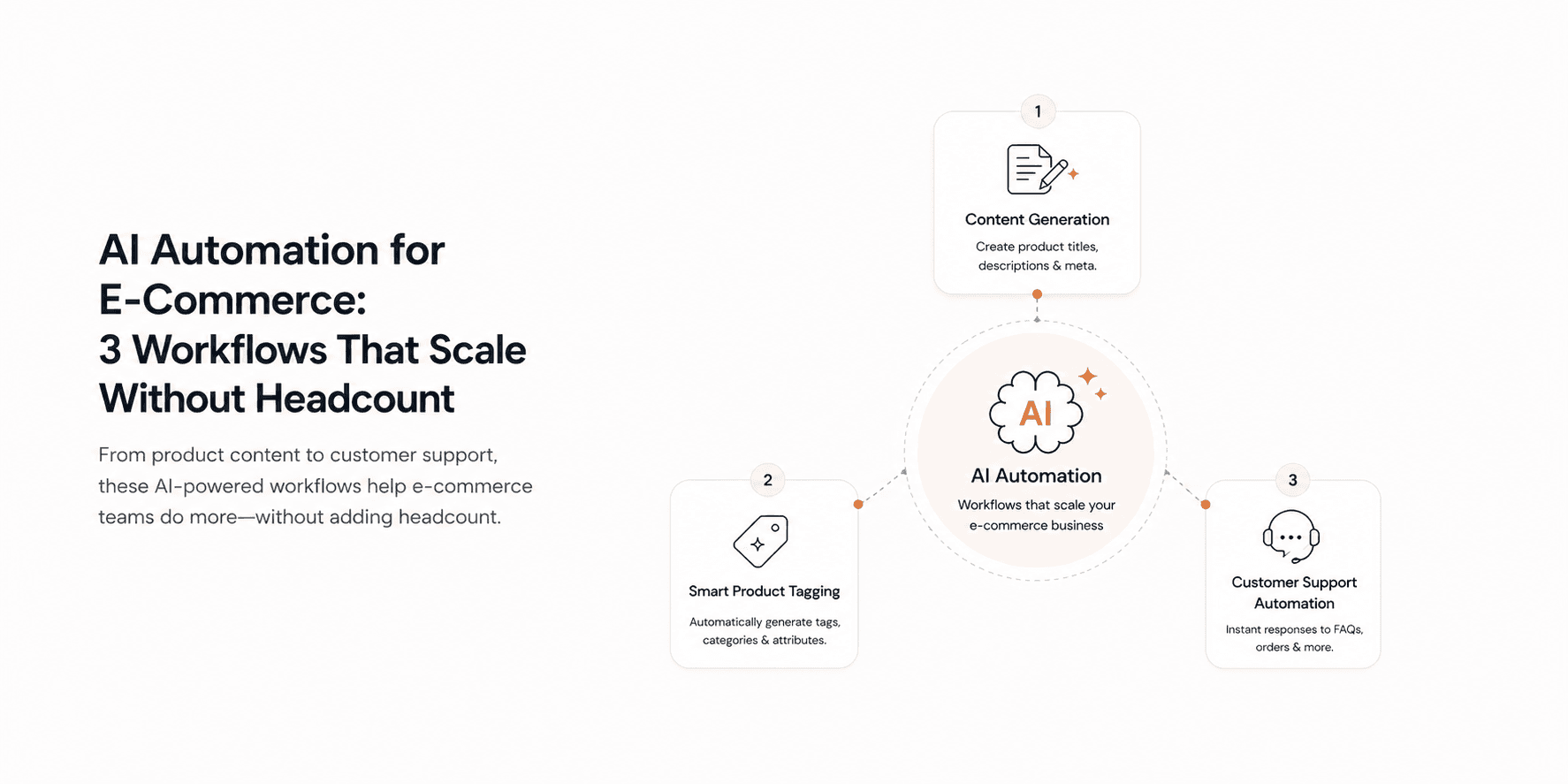
E-commerce automation that scales revenue, not headcount.
E-commerce brands hit a growth ceiling when every new order means more manual work. Inventory updates, pricing changes, customer support tickets, return processing, and fulfilment tracking all scale linearly with order volume. Double your orders, double your workload.
AI automation breaks that linear relationship. The workflows below handle high-volume, repetitive tasks without adding headcount, letting your team focus on strategy, merchandising, and customer experience.
Over 60% of e-commerce operational tasks are repetitive and rule-based, making them strong candidates for AI automation that removes the manual bottlenecks without adding headcount.
7 Workflows That Scale Without Headcount
These seven workflows consistently deliver the highest ROI for e-commerce teams. Each one is high-volume, rule-driven, and produces better outcomes when automated than when managed manually.
1. Inventory Management and Reorder Automation
Stockouts cost revenue. Overstock ties up cash and warehouse space. AI inventory models process sales velocity, seasonal patterns, supplier lead times, and current stock levels to generate reorder recommendations before problems occur. When stock for a SKU is projected to fall below the safety threshold, the system either surfaces a purchase order for review or, where the supplier relationship is configured, raises it automatically. Brands running inventory automation report 30 to 50% reductions in stockout events and meaningful reductions in carrying costs as safety buffer sizes become data-driven rather than guesswork.
2. Dynamic Pricing
Manually monitoring competitor prices across hundreds of SKUs is impractical at any meaningful scale. AI pricing systems pull competitor data continuously, detect price movements, and apply configured repricing rules automatically. A product that is priced 15% above the nearest competitor on a high-competition search term gets adjusted within minutes, not days. Guardrails prevent repricing below margin floors or into territory that would trigger a race to the bottom. Brands using dynamic pricing on competitive product lines report margin improvements alongside volume gains.
3. Customer Support Triage
The majority of inbound support queries fall into a small number of categories: order status, delivery delays, return eligibility, and product questions. AI triage systems classify every inbound ticket at the point of receipt, resolve the ones that have a clear automated answer by querying order management and logistics systems directly, and route the remainder to the appropriate agent with full context pre-filled. Brands report that 60 to 80% of tickets are resolved automatically. Average first-response time drops from hours to seconds. Human agents handle the complex, high-value interactions instead of spending their day answering tracking requests.
4. Returns and Refund Processing
Returns are high-volume and largely rule-based. An AI returns system checks the return request against the policy automatically: is the item within the return window, was it purchased directly, does the reason code qualify? Eligible returns receive a prepaid label by email within seconds. The refund or exchange is triggered as soon as the carrier scan confirms collection. The system logs every decision with the policy rule applied, creating an auditable record and flagging edge cases for human review rather than routing everything through an agent queue.
5. Personalised Email and Abandoned Cart Recovery
Generic broadcast emails perform below the baseline. Behaviour-triggered sequences that respond to what a specific customer did, viewed a category, added to cart, purchased a complementary product, or lapsed for 60 days, consistently outperform them. AI personalisation systems build these sequences dynamically, selecting the product recommendations, subject line variant, and send time most likely to convert based on the individual customer's behaviour history. Abandoned cart sequences with personalised product recommendations recover 5 to 15% of abandoned revenue that would otherwise be lost.
6. Fraud Detection and Order Risk Scoring
Every order carries a fraud risk. Manual review at volume is impossible. AI fraud scoring models assess every order at the point of placement against a set of signals: device fingerprint, IP location, billing and shipping address match, velocity of recent orders from the same payment method, and historical chargeback patterns. High-risk orders are flagged for manual review or declined automatically based on configured thresholds. Brands running AI fraud detection report 40 to 60% reductions in chargeback rates without meaningful increases in false positive declines.
7. Fulfilment and Shipping Optimisation
Carrier selection and rate shopping happen after the order is placed but before it ships. An AI fulfilment system selects the optimal carrier and service level for each order based on destination, weight, dimensions, delivery promise, and current carrier performance data. When a carrier is experiencing delays in a specific region, the system routes new orders to an alternative automatically. Tracking updates are sent to customers proactively when delays are detected, reducing inbound support contacts. Brands report meaningful reductions in shipping costs and a reduction in late delivery complaints.
ROI Benchmarks
Customer support triage delivers the most visible immediate impact. Brands that automate 60 to 80% of inbound ticket volume free their support teams for the interactions that actually require judgement, and see first-response times drop from hours to seconds. This alone typically justifies the investment within the first quarter.
Abandoned cart recovery and personalised email sequences deliver a revenue uplift of 5 to 15% on the recovered segment, with minimal marginal cost once the system is built. Fraud detection reduces chargeback rates by 40 to 60%, which has a direct impact on payment processor fees and account standing. Inventory automation reduces stockout revenue loss by 30 to 50% and typically cuts carrying costs by reducing overstocked buffer quantities.
Across the full stack of seven workflows, e-commerce brands report payback periods of three to six months. The compounding effect, where better inventory reduces support contacts, better fraud detection reduces dispute handling, and better pricing improves margin, means the value compounds well beyond the initial projections.
Recommended Implementation Order
Start with inventory management and customer support triage. Both are high-volume, have clear success metrics, and produce results quickly enough to build internal confidence in automation as an approach. Inventory automation requires clean product and supplier data; run a data audit before building. Support triage requires a labelled dataset of historical tickets; most e-commerce platforms have this available.
In the second phase, add dynamic pricing and returns processing. Pricing requires guardrails to be configured before the system goes live. Returns requires mapping your current policy logic into decision rules, which is a useful exercise in itself. In the third phase, deploy fraud detection, fulfilment optimisation, and personalised email. These tend to require more integration work but deliver significant compounding value once live.
Common Pitfalls
The most common failure in e-commerce automation is building flows without human review escalation paths. When the automated system encounters a case it cannot confidently resolve, it needs to hand off to a human with full context. Systems that dead-end on exceptions, repeating the same response or silently failing, erode customer trust faster than manual handling would.
Deploying pricing automation without margin floor guardrails is a recurring mistake in competitive categories. If two brands both deploy AI repricing without floors, the system will reprice both into a loss-making position in the time it takes to notice. Guardrails are not optional. Set them before the system goes live and review them quarterly as your cost structure changes.
Poor data quality is the most common root cause of inventory automation failures. If your product catalogue has duplicate SKUs, inconsistent supplier lead times, or stale safety stock settings, the AI model will optimise against incorrect inputs. Spend two weeks cleaning product and supplier data before building the automation layer. It is faster and cheaper than debugging poor model outputs in production.
See also AI automation ROI for small business for how to build the ROI case before you commit. Our AI Automation service covers end-to-end design, build, and deployment for e-commerce teams.
Ready to automate your e-commerce operations?
We will map your highest-value automation opportunities and build systems that scale with your order volume, not your team size.