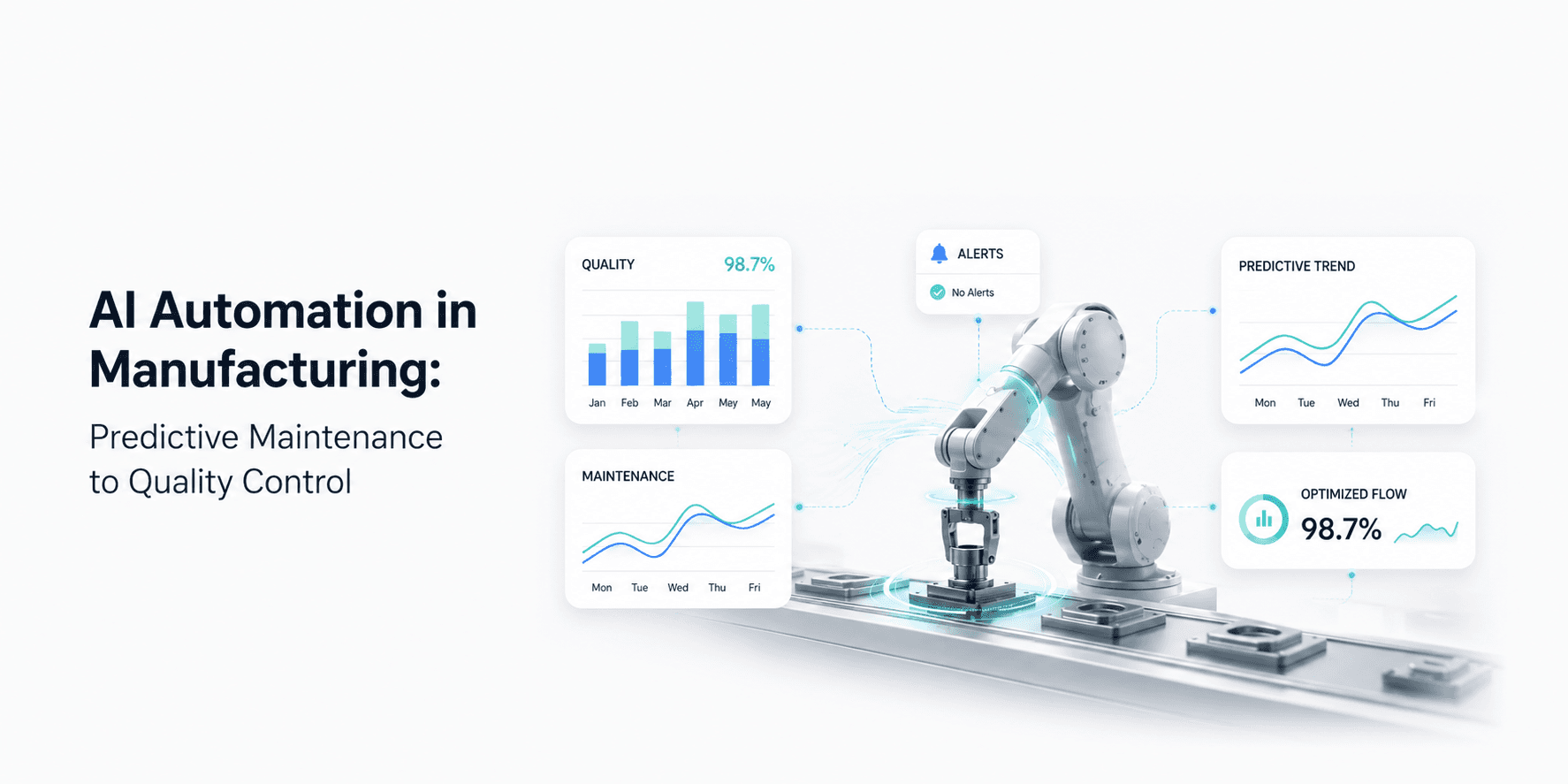
Manufacturing AI that predicts problems before they happen.
Modern manufacturing plants generate terabytes of sensor data every day. Vibration readings, temperature logs, pressure gauges, production line speeds, and quality inspection images flow constantly from every piece of equipment on the floor. Most of that data goes unused.
AI automation transforms that raw data into predictive insights: when a machine will fail, which batches will have quality issues, where bottlenecks are forming, and how to optimise production schedules in real time. The result is less downtime, fewer defects, and higher throughput without adding capacity.
Manufacturing plants using AI-powered predictive maintenance report 30 to 50% reductions in unplanned downtime, with average payback periods under 12 months.
6 Workflows Driving Manufacturing ROI
These workflows address the highest-cost problems in manufacturing: unplanned downtime, quality failures, inventory waste, and production inefficiency.
1. Predictive Maintenance
Vibration sensors, temperature gauges, and acoustic monitors generate continuous readings from every motor, pump, compressor, and conveyor on the plant floor. An AI model trained on historical failure data identifies the signatures that precede breakdowns, typically days or weeks before the fault becomes visible. When a pattern matches a known failure mode, the system creates a work order in your CMMS and alerts the maintenance team with the specific asset, predicted failure type, and recommended action. The machine keeps running. The repair happens during planned downtime, not an emergency shutdown.
2. Quality Control Vision Systems
Camera systems mounted at inspection points capture images of every unit or batch moving through the production line. A computer vision model trained on labelled images of defects, including surface scratches, dimensional errors, colour deviations, and assembly faults, classifies each item in real time. Defective units trigger automatic rejection and diversion. The system logs every decision with the image, classification, and confidence score, creating an auditable quality record and a dataset for continuous model improvement. Defect detection rates consistently exceed human visual inspection, particularly for high-speed lines where fatigue is a factor.
3. Production Schedule Optimisation
Production plans break the moment a machine goes down, a supplier is late, or demand shifts. Manual rescheduling takes hours and rarely finds the optimal sequence. AI scheduling models ingest live data from equipment sensors, ERP order books, and workforce management systems to continuously recalculate the optimal production sequence. When a constraint changes, the system surfaces the updated schedule, with the impact and alternatives explained, so planners can approve and apply it in minutes rather than rebuilding from scratch.
4. Inventory and Supply Chain Forecasting
Raw material shortages and overstock situations both cost money. AI forecasting models process sales data, production schedules, supplier lead times, and external signals such as logistics disruptions and commodity price movements to generate reorder recommendations. When stock levels fall below the dynamically calculated safety threshold, the system raises a purchase order for review or, where the supplier relationship supports it, submits automatically. The result is leaner inventory without the stockout risk that comes from cutting buffers manually.
5. Energy Consumption Optimisation
Energy is one of the largest controllable costs in manufacturing. AI energy management systems monitor consumption at machine and line level, identify inefficient operating patterns, and recommend or execute load-shifting strategies that reduce peak demand charges. In facilities with variable tariffs, the system schedules high-energy processes for off-peak periods automatically. Plants running this capability typically see energy cost reductions of 10 to 20% without any change to production volume.
6. Safety and Incident Monitoring
Camera systems with computer vision models monitor safety zones for PPE compliance, unauthorised entry into restricted areas, and unsafe behaviours such as working without guards in place. Near-miss events are logged automatically, creating a safety record that supports both compliance reporting and root cause analysis. When a safety violation is detected, the system alerts the relevant supervisor in real time. Plants report significant reductions in reportable incidents within the first year of deployment.
Data Infrastructure Requirements
Manufacturing AI depends entirely on the accessibility and quality of your operational data. The minimum requirement is connectivity: sensors must be able to transmit readings to a data collection layer, whether that is a data historian such as OSIsoft PI or AspenTech, a cloud IoT platform, or a direct SCADA integration. If your equipment predates modern connectivity standards, retrofit sensor kits are available for most major asset classes.
Data quality matters as much as data availability. Models trained on incomplete or inconsistently labelled historical data produce unreliable predictions. Before building AI systems, audit your existing maintenance records, quality logs, and sensor archives for completeness. A six-month gap in vibration data for a critical asset means the predictive model has a blind spot. Identifying and filling those gaps before model training is faster and cheaper than debugging poor predictions after deployment.
ROI Benchmarks
Predictive maintenance consistently delivers the fastest payback. Plants report 30 to 50% reductions in unplanned downtime, with maintenance labour costs falling as reactive callouts give way to planned interventions. Machine life extends by 20 to 40% when failures are caught early and wear is managed proactively rather than addressed after a breakdown. The average payback period across deployments is under 12 months on the highest-value equipment.
Quality control automation typically delivers defect rate reductions of 30 to 35% compared to manual inspection baselines, while also increasing line speed, as automated inspection does not require the slower pace needed for reliable human visual checks. Energy optimisation adds another 10 to 20% reduction in energy costs with no capital investment in new equipment. Across a mid-size manufacturing operation, the combined effect of these three workflows alone typically delivers seven-figure annual savings.
Implementation Roadmap
Start with predictive maintenance on your highest-value assets: the equipment where an unplanned failure causes the most lost production time or creates the most expensive downstream disruption. Run the AI system in read-only mode first, generating alerts without acting on them, while your maintenance team validates predictions against what they observe. This validation phase typically runs four to six weeks and produces the ground truth data that refines the model before it is trusted for autonomous scheduling.
Once predictive maintenance is validated and delivering consistent results, expand to quality control automation and then production scheduling. Integrate write-back actions, automatic work orders, automatic PO generation, and schedule updates, only after the read-only phase has established trust in the model outputs. Manufacturing teams that skip this validation step and deploy write-back actions immediately tend to encounter resistance from floor staff and find themselves debugging both the AI and the cultural change at the same time.
See also AI automation in UK healthcare and AI automation ROI for small business for how to build the ROI case before committing to a build. Our AI Automation service covers end-to-end design, build, and deployment for manufacturing operations.
Ready to automate your manufacturing operations?
We will assess your data readiness, identify the highest-value automation opportunities, and build systems that reduce downtime and improve quality.