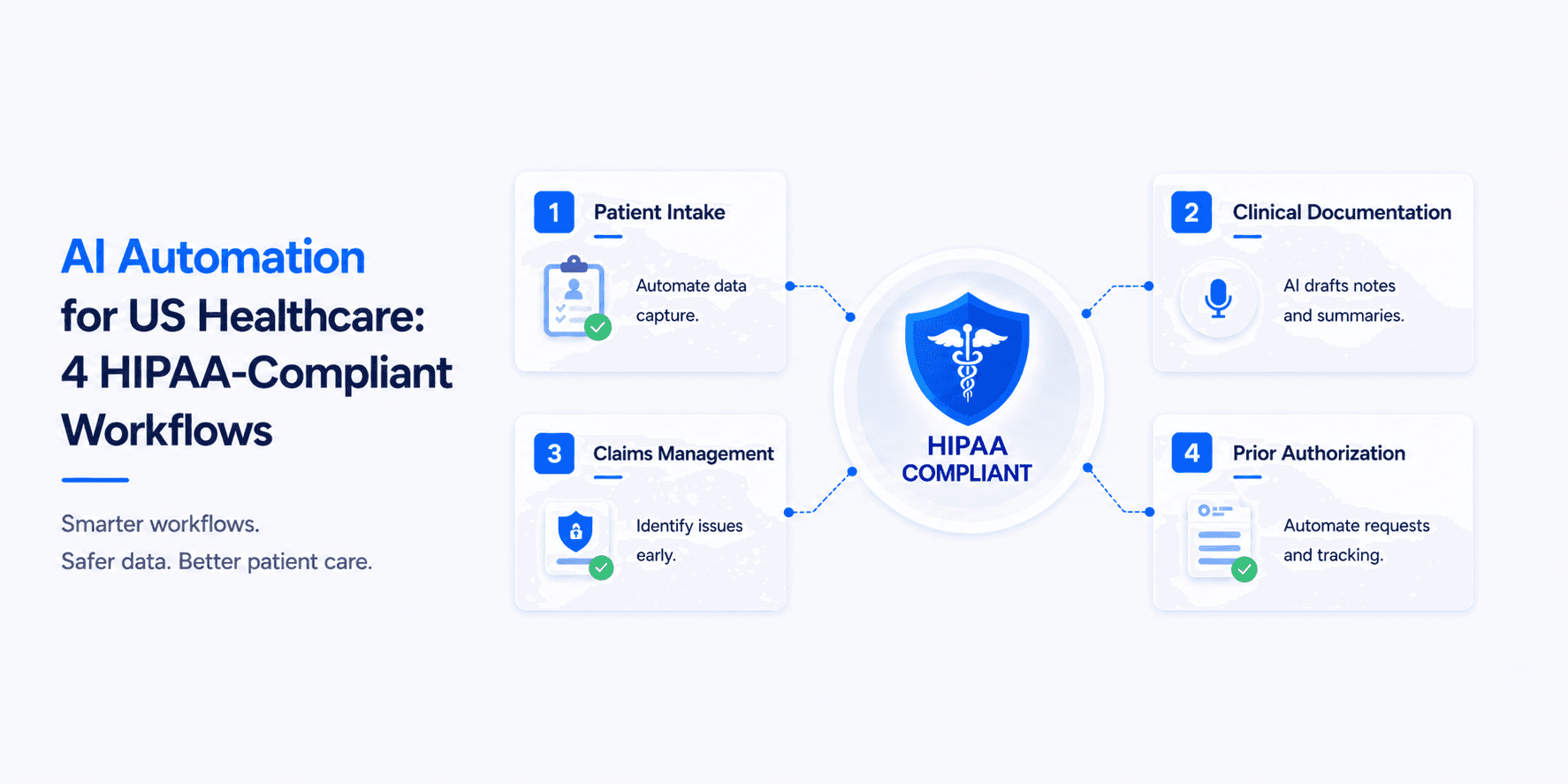
US healthcare spends $1 trillion on admin. AI can automate 30-40% of it without breaking HIPAA.
Administrative overhead is the single largest non-clinical cost in American healthcare. Between prior authorizations, insurance verification, claims processing, and documentation, US physicians spend nearly two hours on paperwork for every one hour of patient care. Front desk staff drown in phone calls, faxes, and portal messages. Revenue cycle teams chase denials that should never have happened.
The opportunity is not theoretical. AI automation can eliminate 30-40% of this administrative burden today -- not five years from now -- using workflows that are fully HIPAA-compliant when built correctly. The practices and health systems doing this well are recovering 15-20 hours per week of staff time and saving $150K-$400K per year in operational costs.
This guide covers seven specific workflows you can automate today, exactly what HIPAA requires for each, and what a realistic implementation looks like for a US practice or health system.
7 HIPAA-Compliant Workflows You Can Automate Today
Each of these workflows replaces high-volume manual tasks with AI-driven automation. They are ordered roughly by implementation simplicity and speed to ROI.
1. Patient Intake and Registration
What it replaces: Clipboard forms, manual data entry from paper or PDF into the EHR, repeated demographic verification at every visit. Staff spend 8-12 minutes per patient on intake tasks that add zero clinical value.
How it works: Patients receive a secure link (SMS or email) before their appointment. They complete demographics, insurance details, medical history, consent forms, and HIPAA acknowledgments digitally. AI validates entries in real time -- flagging mismatched insurance IDs, incomplete fields, and duplicate records. Data flows directly into Epic, Cerner, or athenahealth without manual re-entry.
2. Insurance Eligibility Verification
What it replaces: Staff calling payers or logging into multiple payer portals to verify coverage before appointments. A single verification can take 10-15 minutes when done manually. Multiply that across 30-50 patients per day and you have a full-time role doing nothing but eligibility checks.
How it works: Automated batch eligibility checks run 48 hours before scheduled appointments via real-time EDI 270/271 transactions. The system verifies active coverage, copay amounts, deductible status, and in-network confirmation. Mismatches are flagged for staff review. Patients with lapsed coverage receive automated outreach to update insurance details before arrival.
3. Prior Authorization
What it replaces: The single most hated administrative task in US healthcare. Staff spend an average of 45 minutes per prior authorization request -- gathering clinical documentation, completing payer-specific forms, submitting via fax or portal, and following up on status. The AMA reports that practices submit an average of 45 prior auth requests per physician per week.
How it works: AI extracts relevant clinical data from the patient record, maps it to payer-specific requirements, auto-populates authorization forms, and submits electronically. The system tracks approval status and escalates denials automatically. For CMS-regulated plans, the system follows the CMS Interoperability and Prior Authorization Final Rule (CMS-0057-F) requirements for electronic prior auth.
4. Clinical Documentation (Ambient AI Scribes)
What it replaces: Physicians spending 1-2 hours after clinic typing notes, or expensive human medical scribes ($36K-$50K per year per scribe). Burnout from documentation is the number one driver of physician attrition in the US.
How it works: Ambient AI listens to the patient-physician conversation (with patient consent), generates a structured clinical note in real time, and maps it to the correct EHR fields -- HPI, ROS, assessment, plan. The physician reviews, edits, and signs the note. The AI never finalizes documentation without physician sign-off. Notes are generated in standard formats compatible with Epic, Cerner, and athenahealth.
5. Claims Processing and Denial Management
What it replaces: Manual claims scrubbing, submission, and the painful cycle of denial-rework-resubmission. The average US practice has a 5-10% denial rate, and each denied claim costs $25-$118 to rework. Many practices write off denied claims entirely because the rework cost exceeds the claim value.
How it works: AI scrubs claims before submission -- checking for coding errors, missing modifiers, bundling issues, and payer-specific rules. Claims are submitted electronically via EDI 837 transactions. Denied claims are automatically analyzed for root cause, corrected where possible, and resubmitted. The system tracks denial patterns over time and flags systemic issues (e.g., a specific payer consistently denying a particular CPT code).
6. Patient Scheduling and Reminders
What it replaces: Phone-based scheduling (the average practice receives 50-100 scheduling calls per day), manual reminder calls, and the chaos of no-shows and last-minute cancellations. No-shows cost the US healthcare system an estimated $150 billion per year.
How it works: AI-powered scheduling considers provider availability, room and equipment requirements, patient preferences, and appointment type duration. Automated reminders go out via HIPAA-compliant SMS and email at 72 hours, 24 hours, and 2 hours before appointments. Patients can confirm, cancel, or reschedule via secure links. Cancelled slots are automatically offered to patients on the waitlist.
7. Revenue Cycle Management
What it replaces: The end-to-end revenue cycle -- from charge capture through final payment posting -- typically involves 5-8 different staff members and dozens of manual handoffs. Errors compound at each stage, and the average days in accounts receivable for US practices is 35-50 days.
How it works: AI orchestrates the full revenue cycle: automated charge capture from clinical documentation, real-time coding suggestions (ICD-10, CPT), clean claim submission, payment posting and reconciliation, and patient balance notifications. The system identifies undercoding (leaving money on the table) and overcoding (compliance risk) before claims go out. Dashboards provide real-time visibility into AR aging, collection rates, and payer performance.
HIPAA Compliance: What Every Automation Must Include
HIPAA is not a checkbox. It is a set of technical, administrative, and physical safeguards that must be architected into every system that touches Protected Health Information (PHI). Here is what that means in practice for AI automation.
HIPAA violations are not theoretical risks
OCR enforcement actions in 2024 included penalties ranging from $50,000 to $4.75 million for covered entities that failed to implement adequate safeguards for electronic PHI. AI systems that handle PHI without proper BAAs, encryption, and audit trails create the exact exposure that triggers these penalties.
EHR and System Integrations
AI automation in US healthcare is only as useful as its integration with the systems your practice already runs. Here is how these workflows connect to the major EHR platforms and payer systems.
ROI and What This Costs
The economics of healthcare AI automation are straightforward. Administrative staff time is expensive, errors are expensive, and the volume of repetitive tasks is massive. Here is what practices are seeing in practice.
What Axonari Charges
We build HIPAA-compliant AI automation systems for US healthcare practices and health systems. Pricing depends on the number of workflows, EHR integration complexity, and compliance requirements.
Build Cost
$5K - $35K
One-time implementation depending on number of workflows, EHR integrations, and compliance scope. Single-workflow automations (e.g., scheduling only) start at $5K. Full revenue cycle automation with multi-EHR integration is at the higher end.
Ongoing Support
$1K - $5K/mo
Includes monitoring, maintenance, compliance updates, model tuning, and support. Scales with the number of active workflows and patient volume. Includes BAA coverage and HIPAA audit support.
Key Takeaways
Get a Free Automation Audit for Your Practice
We will map your highest-value automation opportunities, estimate ROI, and scope a HIPAA-compliant implementation plan -- at no cost.