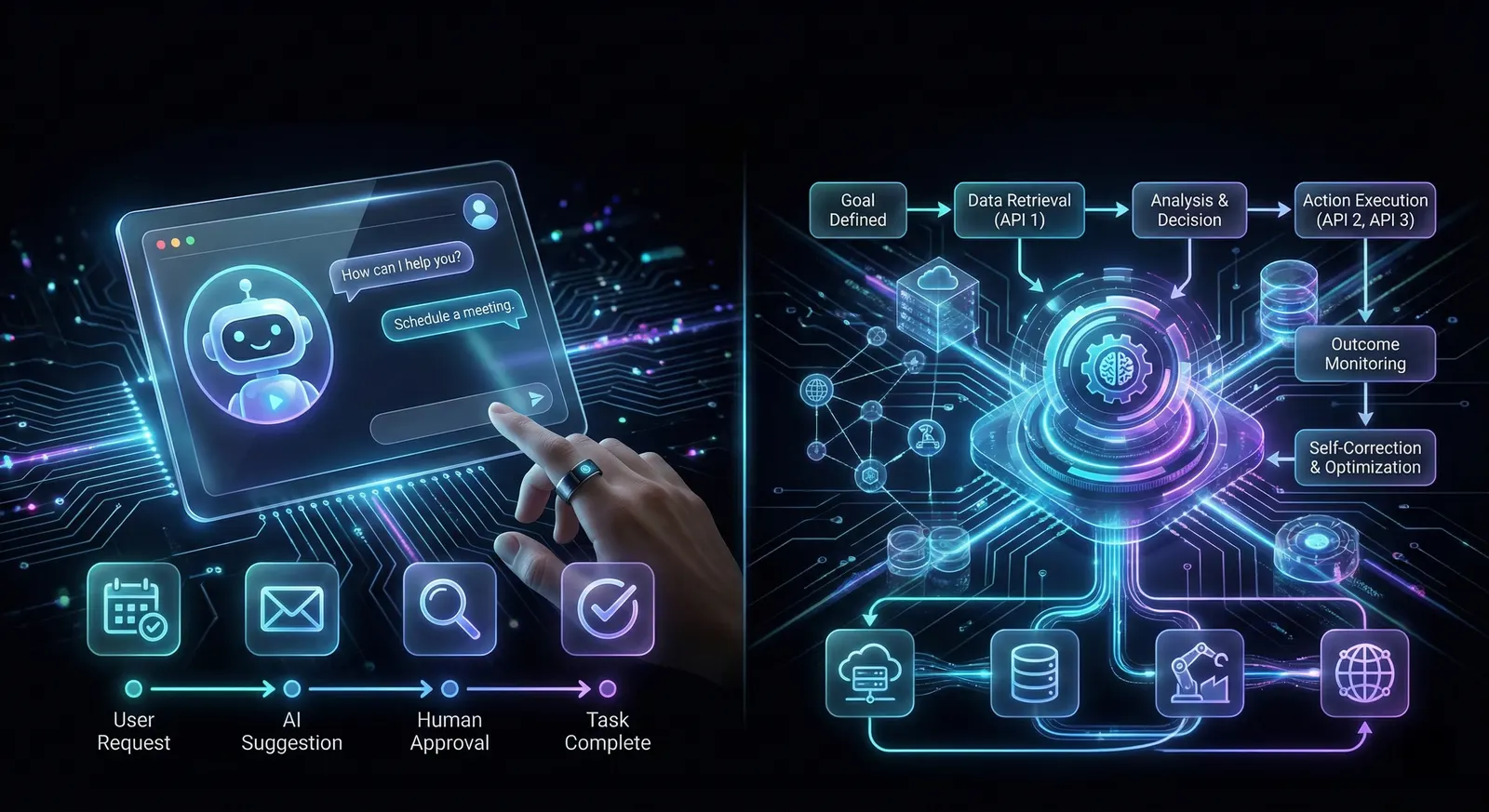
Many people use these terms interchangeably but they represent two very different ways of working with technology. Choosing the right approach is the difference between having a helpful chatbot and building a system that actually gets work done for you.
AI Agents vs AI Assistants: The Key Difference
The Main Point
Think of an assistant as a partner you talk to and an agent as a team member you give a goal. While assistants are great for brainstorming and drafts, agents are built to navigate software and complete tasks without constant supervision.
The Simple Comparison: Brain Power vs Extra Hands
Understanding the fundamental distinction in AI behavior.
Assistants: Your Thinking Partner
These systems are reactive. They wait for you to ask a question or give a prompt. While they are incredibly smart at drafting emails or summarizing long reports, they don't actually go into your other software to finish the job for you.
Agents: Your Digital Workforce
These systems are goal oriented and proactive. Instead of waiting for every single step, you give them a final objective. The agent then plans the necessary steps, connects to your systems, and completes the work on its own.
Moving from Talking to Doing
In this video, we look at how AI is evolving past simple chat boxes. We show real examples of agents navigating enterprise software and making decisions that actually impact the bottom line.
Why many AI projects don't work out
It might be surprising, but most AI projects fail for very human reasons. It is rarely the fault of the technology itself and usually comes down to how the work was designed from the start.
What does an AI Agent actually do?
At a basic level, an AI agent is a system you can trust with a goal. Instead of you manually moving data from one place to another, the agent takes over the process and sees it through to the end.
The process behind the scenes
How to measure success with AI
If you don't keep track of how your AI is performing, it is hard to tell if it is actually helping your business. The best teams look at a few simple metrics to make sure their investment is paying off.
Metrics for Assistants
Time saved for each person every week
How often the team uses the tool
Faster completion of internal tasks
The overall quality of the drafts produced
Metrics for Agents
Percentage of tasks finished independently
Reduction in the cost of each task
How much faster a process becomes
The rate of errors or needed interventions
Choosing your starting point
The choice between an assistant and an agent is about where you want to spend your time.
Path 1: The Assistant
Choose this if you need help with creative work, drafting, or brainstorming. An assistant keeps you in the driver's seat while handling the heavy lifting of research and synthesis. It's about augmenting your individual productivity.
Path 2: The Agent
Choose this if you perform repetitive steps across different software every day. Agents excel where there are clear rules and measurable results. They take the entire process off your plate so you can focus on strategy.
The secret is how humans and AI work together
The most successful companies are not trying to replace their people with technology. Instead, they are rethinking how work gets done so that their team can focus on what they do best while the AI takes care of the rest.
Humans are still the experts when it comes to making complex decisions and navigating uncertainty. AI agents are the experts at staying consistent and handling work at a massive scale.
Keeping your systems safe and compliant
Since AI agents are often given the power to take real actions across different software, security must be built into the system from the very first day. It is not just about protecting data; it is about ensuring every action is authorized and reversible.
Planning for when things go wrong
The tricky thing about AI agents is that they don't always make a loud noise when they fail. Sometimes the errors are quiet and build up over time. Success depends on catching these signals early.
How agents change the way teams work
As AI agents start to take over more of the day to day operations, the structure of your team begins to shift from manual execution to strategic oversight.
"The most successful teams treat their agents like new team members. They need to be trained, monitored, and given regular feedback so they can improve over time."
AI Agent vs AI Assistant: Full Feature Comparison
A clear breakdown of how these two types of AI differ across every dimension that matters.
START YOUR AUTOMATION JOURNEY.
The future of work is not about talking to robots. It is about building a digital workforce that can get the job done for you.